
Dunstall Park Greyhound Stadium: The UK's Newest Track in Wolverhampton
Best Greyhound Betting Sites – Bet on Greyhounds in 2026
 Available in US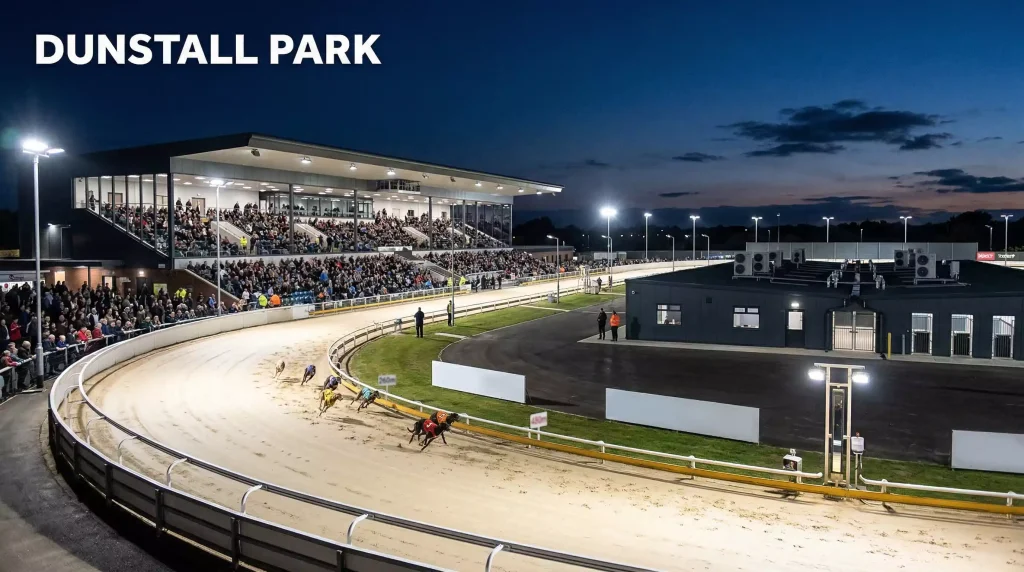
On 19 September 2025, Dunstall Park Greyhound Stadium opened its gates for the first time, and greyhound racing in the Midlands changed overnight. The venue — built on the grounds of Wolverhampton Racecourse by Arena Racing Company — is the first new purpose-built greyhound stadium in Britain in more than a decade. It replaced Perry Barr, the Birmingham track that had served the sport since 1929 but closed its doors for the final time in August 2025.
As Chris Black, the stadium’s general manager, put it ahead of the launch, the opening marked a historic moment for the sport, and he invited enthusiasts, casual racegoers, and first-timers to share it. That ambition — to appeal beyond the core audience — is visible in everything from the design of the spectator areas to the state-of-the-art kennel block. Dunstall Park is not a nostalgic throwback. It is an argument that greyhound racing can invest, modernise, and attract new audiences in 2026 and beyond.
This guide covers what the stadium offers, why the move from Perry Barr happened, and what the racing schedule looks like for anyone planning a visit.
Inside Dunstall Park: Facilities, Kennel Block, and Capacity
Dunstall Park Greyhound Stadium sits within the Wolverhampton Racecourse complex, sharing access roads, parking, and some hospitality infrastructure with the horse-racing venue. The greyhound track itself is a separate facility, purpose-built for the sport, with its own spectator areas, parade ring, and grandstand.
The centrepiece of the investment is the kennel block. Housing up to 116 greyhounds, it features air-conditioned individual kennels, an on-site veterinary suite with X-ray equipment, and purpose-built walking-out areas for pre-race preparation. The standard is materially higher than what most UK tracks offer — Perry Barr’s kennels, by contrast, dated from a different era and lacked modern climate control. For welfare advocates who monitor kennel conditions closely, Dunstall Park represents a tangible step forward.
The track is a standard 400-metre oval with six traps, designed to GBGB specifications for sand-based racing surfaces. The bends are banked to reduce injury risk, and the hare system is the mechanical variety common across modern UK tracks. Track maintenance is handled by a dedicated groundskeeping team, and the going is assessed before every meeting.
Spectator facilities include grandstand seating with clear sightlines across the full circuit, indoor and outdoor viewing areas, a bar, and a restaurant. The layout is modern and spacious — a notable contrast to older stadiums where generations of patchwork additions have produced cramped, labyrinthine spectator areas. Entry pricing follows the standard model: around £5-8 for adults, with under-18s typically admitted free. Parking is available in the racecourse’s main car park.
The shared-site arrangement with Wolverhampton Racecourse also enables something no other British venue has attempted: dual-fixture days. On 7 March 2026, Dunstall Park hosted its first dual fixture — horse racing during the day and greyhound racing in the evening, all at the same location. It is an experiment in programming efficiency and audience crossover that the sport is watching closely.
From Perry Barr to Dunstall: Why the Move Happened
Perry Barr Stadium in Birmingham closed on 23 August 2025 after ninety-six years of operation. The stadium — which opened in 1929 and became one of the sport’s most recognisable venues — had been showing its age for years. The facility required substantial investment to meet modern welfare and safety standards, and Arena Racing Company, which operated the venue, concluded that building new rather than refurbishing old was the better option.
The decision was not without controversy. Perry Barr had deep roots in Birmingham’s sporting culture and a loyal following that spanned generations. Regulars who had attended race nights for decades did not universally welcome the move to Wolverhampton, even if the new facilities were objectively superior. The closure also reduced Birmingham’s live-sport options — the city no longer has a licensed greyhound track, and the nearest alternative is now roughly fifteen miles away at Dunstall Park or Monmore Green.
ARC’s position was that the Dunstall Park investment served the sport better in the long term. The kennel block alone — with its veterinary suite, climate-controlled housing, and capacity for 116 dogs — represented a standard that retro-fitting into Perry Barr’s ageing infrastructure would have been prohibitively expensive. The broader context is an industry navigating a contraction in the number of UK tracks over several decades, from dozens of stadiums in the post-war peak to the 18 that operate today. Within that contraction, the logic of replacing outdated facilities with modern ones — even at the cost of losing historically significant venues — has become the prevailing strategy.
For racing operations, the transition was swift. Perry Barr’s last meeting took place on 23 August, and Dunstall Park’s first public fixture ran less than four weeks later. Trainers, owners, and officials migrated with minimal disruption, and the fixtures that would have been held at Perry Barr were absorbed into Dunstall Park’s schedule.
Racing Schedule and Upcoming Events at Dunstall Park
Dunstall Park runs a regular racing schedule that includes both BAGS daytime fixtures and evening open-race meetings. The stadium hosts afternoon BAGS racing on a rotating rota shared with other GBGB-licensed tracks, with fixtures typically starting between 10:30 and 11:00 and running through to mid-afternoon. These are primarily broadcast for bookmaker feeds and available to watch through SIS and bookmaker streaming platforms.
Evening meetings take place several times a week, typically starting at 19:00 or 19:30 and running for approximately twelve races over two and a half hours. These are the meetings aimed at the attending public, with restaurant packages, bar service, and on-course tote betting available. Premier Greyhound Racing fixtures — broadcast on Sky Sports Racing — are also held at Dunstall Park as part of the PGR calendar, bringing higher-grade racing and larger prize money to the venue.
The dual-fixture concept, where horse racing and greyhound racing run on the same day at the same site, is expected to feature several times across the 2026 calendar. These events are positioned as full-day racing experiences, appealing to fans of both codes. The fixtures are listed on the Wolverhampton Racecourse website and the GBGB’s fixture page, and the scheduling is designed so that the greyhound meeting starts after the horse racing concludes, avoiding overlap.
For visitors planning a trip to Dunstall Park Greyhound Stadium, the most up-to-date schedule is available on the Wolverhampton Racecourse events page and through the GBGB’s online fixture list. Tickets for standard evening meetings can usually be purchased on the gate without advance booking, though restaurant packages and special events may require reservation.
A New Chapter for Midlands Greyhound Racing
Dunstall Park Greyhound Stadium is more than Perry Barr’s replacement — it is a statement about where the sport wants to go. A modern kennel block with veterinary facilities that would have been unthinkable a generation ago. Spectator areas designed for comfort rather than nostalgia. A dual-fixture concept that borrows from horse racing’s playbook and tries something genuinely new.
Whether the investment pays off in sustained attendance and public goodwill is a question the next few years will answer. For now, Dunstall Park gives Midlands greyhound racing a venue it can be proud of — and gives anyone searching for a modern race-night experience a reason to make the trip to Wolverhampton.
The wider context is set out in our guide to watching greyhound racing.
Every other venue is listed in all 18 UK tracks.
