English Greyhound Derby: History, Prize Money, and How to Watch
Best Greyhound Betting Sites – Bet on Greyhounds in 2026
 Available in US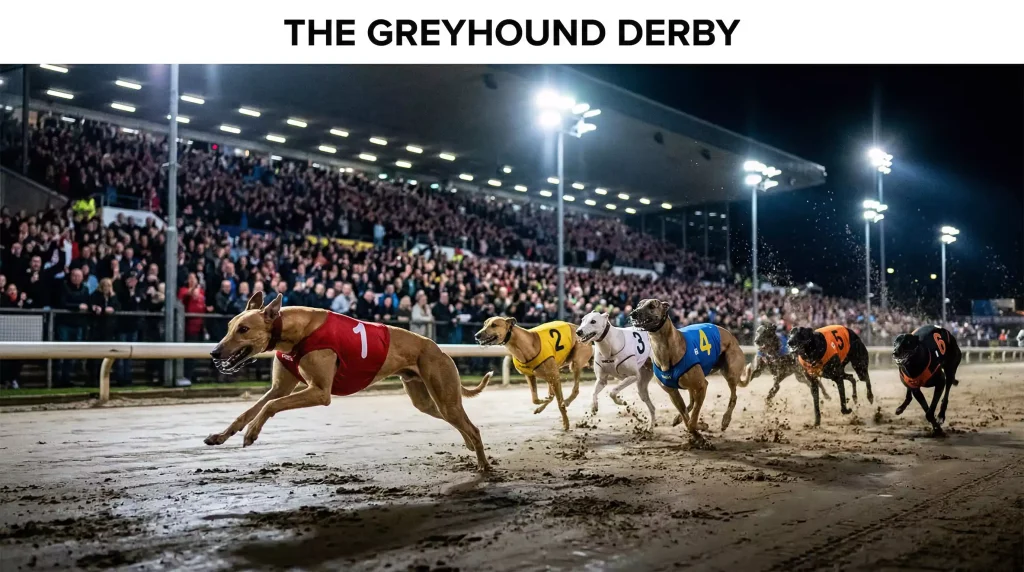
The English Greyhound Derby is the biggest event in the sport. It is to greyhound racing what the Grand National is to horse racing or what the FA Cup final is to football — the one fixture that transcends the regular calendar and draws attention from people who would not normally watch a race. The total prize money distributed across GBGB-licensed racing exceeds £15.7 million in a typical year, and the Derby final commands the single largest purse of any individual competition.
The event has been running since 1927, survived two world wars, moved between some of the most famous sporting venues in London, and eventually settled at Towcester Greyhound Stadium in Northamptonshire — a long way from the bright lights of White City, but a home that has served the English Greyhound Derby well for five consecutive years. This guide covers the history, the format, the money, and how to watch from wherever you are in the UK.
From White City to Towcester: A Brief History of the Derby
The first English Greyhound Derby was held at White City Stadium in west London in 1927, just a year after regulated greyhound racing arrived in Britain from the United States. White City was the home of the sport’s glamour years — a purpose-built stadium that could hold over 90,000 spectators at its peak, attracting crowds that rivalled top-flight football. The Derby was the centrepiece of the calendar from the start, and its early winners became household names in an era when the dogs drew front-page coverage in the national press.
The competition stayed at White City until the stadium’s closure in 1984, after which it moved to Wimbledon Stadium — another London venue with deep racing roots. Wimbledon hosted the Derby for over three decades, becoming synonymous with the event for a generation of fans. The atmosphere on Wimbledon’s Derby night was legendary: packed grandstands, a charged betting ring, and a sense of occasion that no other fixture in the sport could match.
When Wimbledon closed in 2017 — the site was sold for redevelopment — the Derby needed a new home. After a disrupted period that included the pandemic, the competition settled at Towcester Greyhound Stadium, where it has been held since 2021. Towcester is not London, and the move was initially met with scepticism from purists who associated the event with the capital. But the venue has proven itself: a well-maintained 500-metre circuit, modern facilities, and a commitment from the local team to staging the event with the profile it deserves. The 2025 final was held on 14 June at Towcester, and the competition is expected to return there in 2026.
Format, Rounds, and the £175,000 Prize
The English Greyhound Derby is a knockout competition held over several weeks, with the best dogs in the country competing across multiple rounds to reach a six-dog final.
The format begins with early-round heats staged at the host track, drawing entries from trainers across the UK and Ireland. Dogs qualify based on performance — finishing position and time — with the fastest and most consistent runners progressing through quarter-finals and semi-finals. Each round eliminates weaker contenders, and by the time six dogs load into the traps for the final, each has survived multiple races against elite-level opposition. The semi-finals and final are the headline events — broadcast live on Sky Sports Racing, covered in depth by the racing press, and attracting the largest crowds of the greyhound year.
The prize money is the highest in the sport. The 2025 English Greyhound Derby offered £175,000 to the winner, with a total prize fund of £235,000 distributed across the finalists and earlier-round participants. To put that in context, most open-race evening meetings offer prize money in the low hundreds of pounds per race. The Derby final pays more for a single thirty-second race than many tracks distribute across an entire week’s fixtures. The runner-up alone takes home more than the winner of most other greyhound competitions in Britain.
The standard of racing in the Derby final is typically several grades above what you would see at a regular BAGS fixture or even a standard open-race evening card. The dogs are faster, the margins are tighter, and the tactical element — trap draw, early pace, running lines through the bends — is amplified by the quality of the field. The Derby winner goes on to become the most valuable stud dog or brood bitch in the sport, with breeding rights commanding significant fees. For owners and trainers, winning the English Greyhound Derby is a career-defining achievement that brings financial rewards well beyond the prize money itself.
How to Watch the Derby: TV, Streaming, and At the Track
The English Greyhound Derby final is the most widely broadcast greyhound race of the year. Sky Sports Racing carries the semi-finals and final live, with extended studio coverage, build-up analysis, expert commentary, and post-race interviews. If you have access to Sky Sports — through a Sky subscription, Virgin Media, or a NOW TV Sports pass — the Derby is part of the package.
For viewers without Sky, bookmaker streaming platforms carry the race. bet365, with its funded-account requirement of at least £1, streams every round of the Derby through its greyhound section. Other bookmakers with streaming services — William Hill, Betfair — typically carry the final at minimum. RPGTV on Freeview may provide some coverage of earlier rounds, though the primary broadcast rights for the semi-finals and final sit with Sky Sports Racing under the Premier Greyhound Racing deal.
Watching at the track is the premium experience. Towcester on Derby night has an atmosphere that does not replicate through a screen — the noise when the traps open, the roar from the crowd on the final bend, the tension in the seconds before the photo-finish result is announced. Tickets for the final are sold in advance and often include restaurant and hospitality packages. Standard admission is available, but the best trackside positions tend to be reserved for package holders. If you plan to attend, booking early is advisable — the Derby final is one of the few greyhound racing events in the UK that routinely sells out its premium seating.
For those who cannot make it to Towcester, many betting shops show the Derby final on their in-shop screens through SIS, making it accessible on the high street as well as at home. The final is usually run on a Saturday evening in June — around 20:00 — which makes it convenient for television viewers, pub watchers, and anyone marking the race as a social occasion.
The Derby: Greyhound Racing’s Biggest Night
The English Greyhound Derby is the one event that reminds everyone — including people who never watch greyhound racing — that the sport exists and, at its best, is spectacular. A six-dog field of the fastest greyhounds in the country, sprinting around 500 metres of sand track, with £175,000 on the line. It is over in less than thirty seconds, and those seconds are the most valuable in the sport.
Whether you follow greyhound racing every day or only dip in once a year, the Derby is the fixture to watch. It is the sport’s showcase, its biggest prize, and its strongest claim to mainstream sporting attention. Towcester in June is where the greyhound calendar peaks — and it is worth making the effort to be there, or at least to be watching.
The wider context is set out in our guide to watching greyhound racing.
The rest of the calendar is in racing events.
