
Greyhound Racing Tips: Strategies for Smarter Selections
Best Greyhound Betting Sites – Bet on Greyhounds in 2026
 Available in US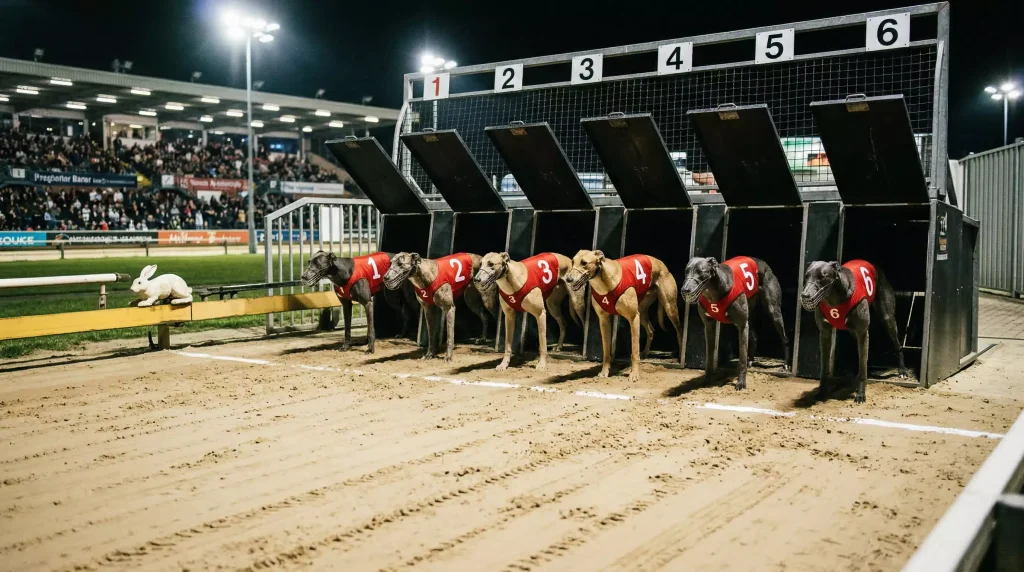
There are no guaranteed winners in greyhound racing. Anyone who tells you otherwise is selling something. The sport is fast, chaotic, and decided in thirty seconds — and in those thirty seconds, a bump on the first bend, a slow start from the traps, or a dog that simply does not fancy it tonight can overturn the most careful analysis. As BGRF chairman Joe Scanlon observed when reflecting on the industry’s financial landscape, even the revenue streams that sustain the sport are a long way from their historic highs. Nothing about greyhound racing is certain.
What good greyhound racing tips can do is shift the odds in your favour over time. Not on every race, not even on most races, but across a sustained run of selections where you have applied a method rather than guessing. The UK gambling industry generated £16.8 billion in gross gambling yield in 2024-25, and bookmakers did not build that figure by losing to uninformed punters. With an estimated £800 million in annual bookmaker turnover on licensed greyhound racing alone, the information asymmetry favours the house. Narrowing that gap, even slightly, is what strategy is for.
This guide covers three practical approaches — trap bias, early speed, and each-way value — that form the foundation of most successful greyhound selections. No hype, no guaranteed systems, just tools that work when applied consistently.
Trap Bias: Why Start Position Matters More Than You Think
Every greyhound track in the UK has a trap bias — a statistical tendency for certain starting positions to produce more winners than others. The bias is determined by the track’s geometry: the angle and tightness of the first bend, the width of the home straight, and the position of the hare rail. At tracks with a sharp first bend close to the start line, inside traps (1 and 2) are heavily favoured because dogs on the rail reach the bend first and do not have to navigate around other runners. At tracks with a longer run to the first bend, the bias is more balanced.
The practical application is straightforward. Before selecting a dog, check the trap statistics for the track and distance. Racing Post and several specialist greyhound data sites publish trap-bias tables that show win percentages by trap number at every GBGB-licensed stadium. If trap 1 at Romford over 400 metres wins 28% of the time — nearly double the expected rate of 16.7% in a six-dog race — any dog drawn in trap 1 starts with a built-in advantage that the race card will not tell you about.
Trap bias is most valuable in lower-grade races where the margins between dogs are small. In an A7 or A8 race with evenly matched runners, the dog in the statistically favoured trap will win more often than its form alone would suggest. In high-grade open races, where one or two dogs may be significantly faster than the rest, trap bias matters less — raw ability overrides positional advantage. Adjust your weighting accordingly.
One caveat: trap bias is a long-term statistical tendency, not a guarantee for any individual race. A dog with poor form in trap 1 at a track with strong inside bias is still unlikely to win. The bias improves the chances of competent dogs in favourable draws — it does not manufacture winners from poor runners.
Early Speed and Sectional Times: Finding the Pace Setters
Greyhound races are won and lost in the first three seconds. The break from the traps and the run to the first bend determine which dog gets the lead, which gets a clear run, and which gets boxed in behind other runners. A dog with fast early speed — measured by its sectional time to the first bend — is more likely to avoid trouble and race on its own terms.
Sectional times are published by Racing Post and some track-specific results services. They measure the time from the traps opening to the dog reaching a specific point — usually the first bend or a measured point on the back straight. A fast sectional indicates a dog that breaks sharply and leads into the first bend. A slow sectional suggests a dog that takes time to hit full stride and relies on running on (finishing strongly in the latter stages of the race).
For greyhound racing tips purposes, early speed is most valuable at tracks where the first bend comes quickly after the start line — Romford, Monmore, and other tight circuits. At these tracks, the dog that leads into the first bend wins a disproportionate share of races, because the tight bends make it difficult for dogs behind to pass. At tracks with longer runs to the first bend — Towcester’s 500-metre course, for example — late pace and stamina carry more weight.
When using sectional times, compare like with like. A fast sectional at Nottingham over 480 metres is not directly comparable to a fast sectional at Romford over 400 metres — the distances to the timing point differ, and the track geometries produce different dynamics. Compare sectional times within the same track and distance to identify which dog in tonight’s field is most likely to lead into the first bend.
The Each-Way Approach: Lower Risk, Consistent Returns
Most recreational greyhound bettors back dogs to win. It is the simplest bet, the most intuitive, and the one that produces the most satisfying result when it lands. It is also the hardest to make profitable over time, because you need to pick the winner from a six-dog field — and in a sport as unpredictable as greyhound racing, even the best dog in the race loses more often than it wins.
The each-way bet offers a more forgiving alternative. By backing a dog to finish first or second, you double the number of outcomes that produce a return. The place part of the bet typically pays at one quarter of the win odds, so a £5 each-way bet at 5/1 costs £10 (two separate bets) and returns £11.25 if the dog finishes second — a modest £1.25 profit — or £41.25 if it wins.
The each-way approach works best with mid-priced selections — dogs at odds of roughly 3/1 to 6/1. At shorter prices (evens or 2/1), the place return is too small to justify the doubled stake. At longer prices (8/1 or higher), the dog is an outsider that is unlikely to place consistently. The sweet spot is the dog that the market rates as competitive but not favourite — the second or third choice that regularly finishes in the first two without always winning.
Over a sustained run of bets, the each-way approach produces smaller individual wins but a higher strike rate. For anyone following greyhound racing tips as a recreational activity rather than a profession, the lower variance makes the experience more enjoyable — you collect returns more often, your bank lasts longer, and the inevitable losing runs feel less punishing.
Tips Are Tools, Not Guarantees
Trap bias, early speed, and each-way value are strategies, not systems. They improve your selection process and give you a framework for making informed decisions, but they do not eliminate the uncertainty that makes greyhound racing compelling in the first place. The dogs do not read the form book. The traps do not always open cleanly. The first bend is chaos more often than it is predictable.
Use these greyhound racing tips as starting points, not endings. Combine them with form analysis, adjust them for the specific track and conditions, and always — always — set a budget before you start betting. The best tip in any sport is the one you can afford to lose on.
The wider context is set out in our guide to watching greyhound racing.
