
Greyhound Racing vs Horse Racing: Key Differences Compared
Best Greyhound Betting Sites – Bet on Greyhounds in 2026
 Available in US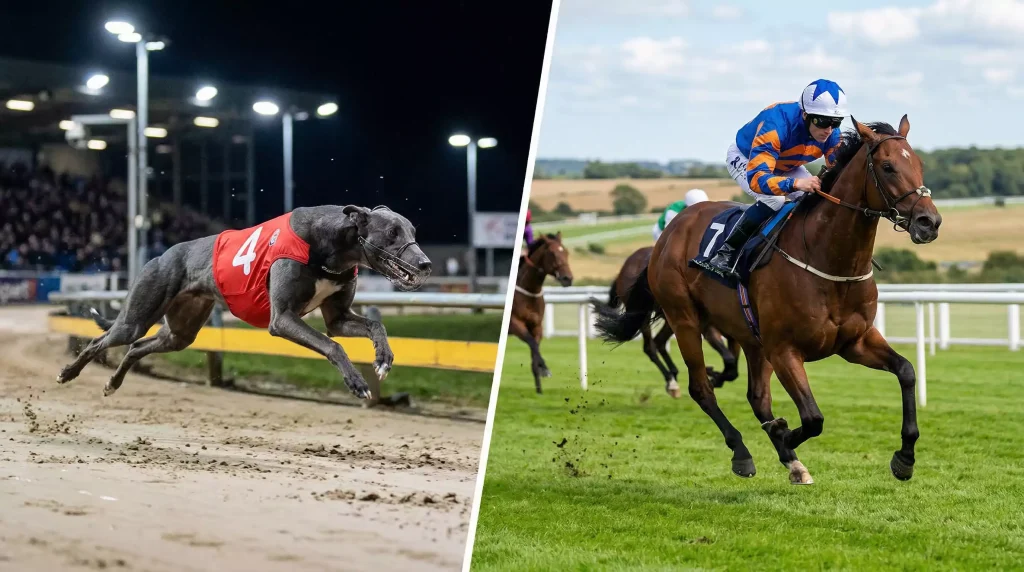
Greyhound racing and horse racing are the two animal-racing sports that dominate British betting culture, and at first glance they look like variations on the same theme: animals race around a track, punters bet on the outcome, and the winner crosses the line first. The similarities end there. The two sports differ in format, frequency, betting dynamics, cost of attendance, atmosphere, and the profile of their audiences. Understanding those differences is useful whether you are a horse-racing fan curious about the dogs, a greyhound follower wondering how the other half lives, or a newcomer deciding which sport to try.
Greyhound racing contributes £164 million annually to the UK economy and supports around 5,400 jobs. Horse racing’s economic footprint is considerably larger — measured in billions rather than millions — but the comparison is not about scale. It is about what each sport offers the viewer, the bettor, and the casual visitor on a night or afternoon out.
Race Format: Speed, Frequency, and Track Design
The most immediate difference is pace. A greyhound race lasts roughly thirty seconds. A horse race lasts between one and seven minutes depending on the distance. This changes everything about the viewing experience. Greyhound racing is intense and relentless — a twelve-race card produces twelve bursts of action in under three hours, with each race separated by a gap of just twelve to fifteen minutes. Horse racing is more measured: a six-race card at a flat meeting takes two to three hours, with twenty to thirty minutes between races.
Track design reflects the different animals. Greyhound tracks are compact ovals — typically 250 to 500 metres in circumference — with sand surfaces and mechanical hares. Horse-racing courses are sprawling layouts that can stretch over a mile, with turf or all-weather surfaces, varying terrain, and natural obstacles in jump racing. On 7 March 2026, Dunstall Park in Wolverhampton hosted a dual fixture — horse racing by day and greyhound racing by evening on the same site — which was the first time a British venue had staged both codes on the same day. The experiment illustrated how the two sports can coexist physically while remaining entirely different in character.
Field sizes also differ. A standard greyhound race features six runners. Horse races vary from four to over thirty runners in the biggest handicaps. Fewer runners in greyhound racing means a higher baseline probability of picking the winner by chance — roughly 16.7% per runner, compared to as low as 3% in a large horse-racing field. This does not make greyhound racing easier to profit from — bookmaker margins adjust accordingly — but it does make the betting feel more accessible for beginners.
Betting Dynamics: Odds, Markets, and Value
The betting markets for greyhound racing vs horse racing differ in depth, liquidity, and volatility. Horse-racing markets are deep — thousands of punters bet on every race, odds are widely quoted from early morning, and the markets are generally efficient. Greyhound markets are thinner. Fewer people bet on each race, the odds are often not published until shortly before the off, and individual large bets can move the price significantly.
This thinness cuts both ways. For informed bettors, it creates opportunities: a dog whose form suggests it should be 3/1 might drift to 5/1 in a market where nobody else has done the analysis. For uninformed bettors, it means the price they see is less reliable as a guide to the dog’s actual chances — the market has not been stress-tested by the volume of opinion that a horse-racing market receives.
Bet types are broadly similar across both sports. Win, each-way, forecast, and tricast bets work the same way. The main difference is in exotic bets: horse racing offers more complex accumulators, ante-post markets months in advance, and specials around major festivals. Greyhound racing’s ante-post betting is limited to the biggest events — the Derby, the St Leger, the Oaks — and the everyday markets are simpler: win, place, forecast, tricast, and combination bets.
The frequency of greyhound racing amplifies the betting volume. With twelve or more races on an evening card and BAGS fixtures running all afternoon, a greyhound bettor can place significantly more bets per day than a horse-racing equivalent. This is a feature for entertainment but a risk factor for anyone who struggles with control. Setting deposit limits and session limits is particularly important for high-frequency greyhound betting.
The Spectator Experience: Cost, Atmosphere, and Accessibility
The cost gap between the two sports is substantial. Standard admission to a greyhound meeting costs £5-8, with under-18s free at most tracks. A day at the horse races starts at around £15-20 for the cheapest enclosures at a flat meeting and scales rapidly upward — a Premier Enclosure badge at a major festival can cost £40-80 or more, before transport, food, and drink. The total cost of a day at Royal Ascot or Cheltenham is in a different financial universe from a Wednesday evening at Romford.
The atmosphere reflects the pricing. Horse racing’s premium meetings are social occasions with dress codes, champagne bars, and celebrity spotting. Greyhound racing’s atmosphere is more casual, more local, and more focused on the racing itself. A Saturday evening at a well-attended greyhound track — the buzz of conversation, the commentary over the tannoy, the roar when the traps open — has an energy that is genuine and unpretentious. It is a night out at the pub, with live sport. Horse racing’s bigger meetings aim for a day at the event, with the racing as the backdrop.
Accessibility favours greyhound racing. Most tracks are in or near urban centres, run evening fixtures that fit a working schedule, and require no advance planning. Horse racing often involves travel to rural courses, daytime fixtures on weekdays, and the kind of forward planning that makes spontaneous visits difficult. As Mark Moisley of the GBGB has observed, greyhound racing remains one of the top ten spectator sports in the UK, and its accessibility — in price, location, and schedule — is central to that status.
Both sports have strengths the other lacks. Horse racing offers drama over distance, the spectacle of jump racing, and a social cachet that greyhound racing does not pretend to match. Greyhound racing offers speed, frequency, affordability, and an informality that horse racing — for all its grandeur — cannot replicate. They are not competitors so much as complements, and many racing fans follow both. The dual-fixture experiment at Dunstall Park points to a future where the two sports share infrastructure and audiences, and the early results suggest there is an appetite for exactly that kind of crossover.
Two Sports, One Thrill
The comparison between greyhound racing vs horse racing is not a contest with a winner. The two sports serve different audiences in different ways, and both deliver the same fundamental appeal: live animals racing for real, with outcomes that matter to the people watching. Greyhound racing is faster, cheaper, and more frequent. Horse racing is grander, deeper, and more socially embedded. The best approach is to try both and see which one — or which combination — fits your schedule, your budget, and your idea of a good time.
The wider context is set out in our guide to watching greyhound racing.
