
Greyhound Tracks in the UK: The Complete 2025–26 Stadium Guide
Best Greyhound Betting Sites – Bet on Greyhounds in 2026
 Available in US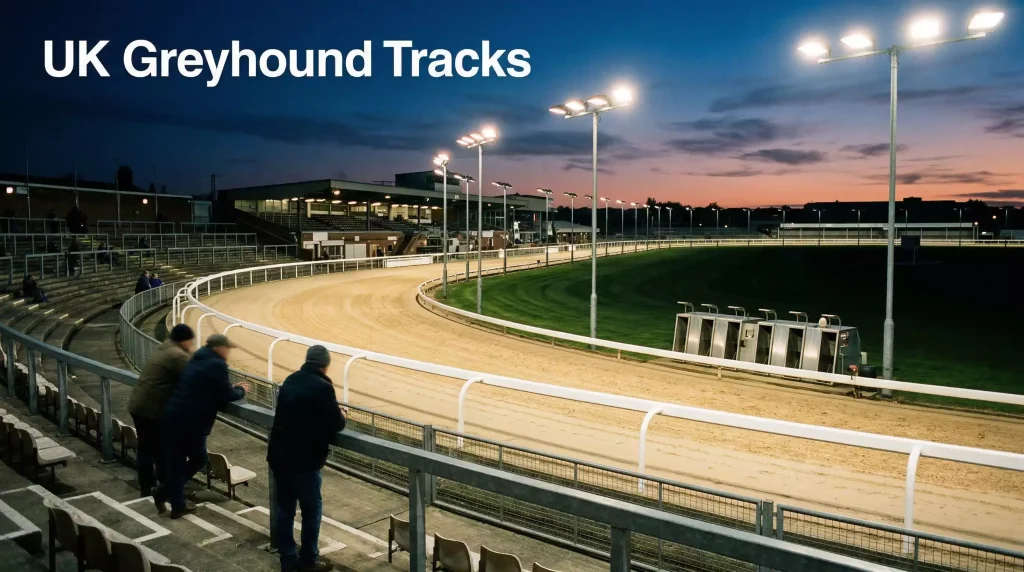
Britain’s greyhound tracks are not glamorous places. They do not have the manicured lawns of Ascot or the celebrity-packed paddocks of Cheltenham. What they have instead is something harder to manufacture: atmosphere. The floodlights warming up against a darkening sky, the mechanical hare clicking into position, the collective intake of breath as the traps spring open — this is the raw theatre that draws more than two million spectators through UK turnstiles every year.
The map of greyhound tracks UK fans can visit has changed more in the past two years than in the previous decade. Stadiums have closed, a major new venue has opened, and the geography of the sport has shifted. If you are working from memory — or worse, from a list published before 2025 — there is a fair chance your information is out of date. This guide corrects that. It covers every GBGB-licensed stadium operating in the 2025–26 season: where they are, what they offer, and what has changed since you last checked.
We will work through the tracks region by region, starting with the broader picture before zooming into the specifics. If you already know your nearest stadium and just want practical advice on visiting, skip ahead to the planning section. If you are looking for the full inventory — all eighteen venues, mapped and described — read on from here.
All 18 GBGB-Licensed Tracks on the Map
As of January 2026, the Greyhound Board of Great Britain licenses 18 stadiums across England and Wales. There are no active licensed tracks in Scotland — the last Scottish venue closed years ago, and recent legislative moves to ban the sport there have made a return unlikely. Northern Ireland operates under a separate regulatory framework and is not covered by the GBGB licence.
The distribution of those eighteen tracks is heavily weighted towards England’s urban centres. London and the South East account for four stadiums. The Midlands and the North West each have a strong presence. East Anglia, Yorkshire, the North East, and the South West are represented by one or two venues apiece. Wales has a single licensed track, in Cardiff. The pattern reflects the sport’s roots as an urban, working-class entertainment — greyhound racing grew up where the factories were, and the surviving stadiums still cluster around the cities that built them.
Here is the full list, grouped by region, before we examine each one in detail:
| Region | Stadiums |
|---|---|
| London & South East | Romford, Central Park (Sittingbourne), Brighton & Hove, Harlow |
| East Anglia & East | Yarmouth, Mildenhall (Suffolk) |
| Midlands | Monmore Green (Wolverhampton), Dunstall Park (Wolverhampton), Oxford, Nottingham, Kinsley |
| South & South West | Towcester |
| Yorkshire & North West | Doncaster, Sheffield (Owlerton) |
| North East | Newcastle, Sunderland, Pelaw Grange (Chester-le-Street) |
| Wales | Valley Stadium (Ystrad Mynach) |
A note on naming: some tracks are known locally by names that differ from their official listing. Monmore Green is sometimes called Wolverhampton Greyhound Stadium. Sheffield is widely known as Owlerton. If you are searching online, try both the venue name and the city name to find the right information.
England: 17 Stadiums by Region
London and the South East
Romford is the closest greyhound track to central London and the most accessible by public transport. Located in the London Borough of Havering, it sits a short walk from Romford station on the Elizabeth Line, which puts it within easy reach of anyone in east or central London. Race nights run multiple times a week, with Saturday evenings being the busiest. The stadium has a modern grandstand with restaurant facilities, a bar, and trackside seating. For anyone asking “where can I watch greyhound racing near London?” — Romford is the first answer.
Brighton and Hove Greyhound Stadium sits on the south coast, operated by Entain (the parent company of Ladbrokes). It runs a regular weekly schedule and draws from a catchment area that covers Sussex and the wider south-east. The venue hosted a live YouTube show for Greyhound Racing UK in 2025, reflecting its continued relevance in the broadcast landscape. The atmosphere is lively on race nights, with a restaurant overlooking the track and bar facilities for casual spectators.
Central Park in Sittingbourne, Kent, serves the wider South East beyond London’s orbital motorway. It is primarily a car-access venue, positioned off the A2 corridor between London and the Channel ports. Arena Racing Company operates the stadium, which runs regular race meetings and is a popular choice for group bookings and work socials from the Canterbury, Maidstone, and Medway areas.
Harlow Stadium in Essex provides another option for those in the London orbit. Located just outside the M25, it operates under GBGB licence and runs multiple meetings each week, including morning and evening fixtures. The stadium serves a wide catchment area covering Essex, Hertfordshire, and the northern Home Counties.
East Anglia and the East
Yarmouth is one of two GBGB-licensed tracks in this part of the country. Located in Great Yarmouth, Norfolk, it combines greyhound racing with its seaside setting — an unusual pairing that gives race nights a different flavour from the urban stadiums. The track runs throughout the year but is particularly popular during the summer tourist season, when it draws both racing regulars and holidaymakers looking for an evening’s entertainment.
Mildenhall Stadium, also known as Suffolk Downs, sits in the Suffolk countryside near the town of Mildenhall. The venue suffered a fire in July 2024 that caused significant damage to facilities and has been closed since, with a return expected in late 2025 or early 2026. Before the fire, the track ran a regular BAGS schedule serving Suffolk, Norfolk, and Cambridgeshire. Checking the current status before planning a visit is strongly recommended.
The Midlands
The Midlands is the heartland of British greyhound racing in 2026, with five licensed stadiums across the region. Monmore Green in Wolverhampton is the longest-established of the group, a traditional oval track with a reputation for competitive graded racing. It has a strong BAGS schedule and is a regular fixture on bookmaker TV feeds throughout the afternoon and evening.
Dunstall Park, also in Wolverhampton, is the newest addition to the map — opened in September 2025 as the first new greyhound track in the UK in over a decade. We will cover Dunstall Park in detail in the next section, because its story is central to understanding where the sport is heading.
Oxford Stadium, in Cowley, has a racing history stretching back decades and hosts both graded and open racing. In 2026, it welcomes several Category One and Two events to its schedule, including the Sandy Lane Sprint and the Oxford Puppy Collar. The track runs multiple meetings each week and benefits from its location in a university city with strong transport links.
Nottingham rounds out the Midlands contingent with a busy schedule that includes both daytime BAGS meetings and evening fixtures. It earned its own moment in the spotlight recently when a Boxing Day meeting drew its largest crowd in recent memory — more than a thousand spectators, a figure that underlines the enduring appeal of the sport as a social event.
Kinsley Stadium in West Yorkshire sits on the western edge of this region, serving the area between the M1 and the M62. It is a smaller track with a committed local following, running a regular BAGS schedule that feeds the bookmaker broadcast network.
South and South West
Towcester, in Northamptonshire, holds a unique position among greyhound tracks UK fans should know about. It is the home of the English Greyhound Derby — the sport’s most prestigious race, carrying a winner’s prize of £175,000. The stadium is shared with a horse-racing course, which gives it a scale and infrastructure that most standalone greyhound venues cannot match. Towcester has hosted the Derby since 2021 and has established itself as the sport’s flagship venue for set-piece events.
Yorkshire
Doncaster and Sheffield serve the Yorkshire and South Yorkshire corridor. Both are established stadiums with regular BAGS schedules and evening fixtures. Doncaster is located near the town’s racecourse area and is accessible from the A1(M). Sheffield’s Owlerton Stadium has a loyal local following and includes conferencing and entertainment facilities alongside the racing. Owlerton also hosts speedway, giving the venue a dual-sport identity that broadens its appeal.
The North East
Newcastle and Sunderland form a pair in the North East, joined by Pelaw Grange in Chester-le-Street. Newcastle’s stadium has a long history and a strong reputation for competitive racing, including regular hosting of Premier Greyhound Racing events. The All England Cup final, held at Newcastle in 2025, saw attendance rise by 85 percent year on year — a sign of growing interest in the region’s flagship greyhound event.
Sunderland is a workhorse track with a reliable BAGS schedule. It contributes a steady stream of content to the SIS broadcast feeds that supply bookmaker TV and streaming platforms. For punters who follow afternoon racing through bet365 or William Hill, Sunderland is one of the names that appears most frequently on the daily card.
Pelaw Grange, also known as Star Pelaw, sits near Chester-le-Street in County Durham. The track’s Untold Racing Stewards Cup was upgraded from Category Two to Category One status for 2026, recognising the venue’s growing significance in the sport’s competitive calendar.
Wales: Valley Stadium, Ystrad Mynach
Valley Stadium in Ystrad Mynach, near Caerphilly, is the only GBGB-licensed track in Wales — and its future carries a degree of uncertainty that no English stadium currently faces. The Welsh Government announced in February 2025 that it intended to ban greyhound racing, and recent legislative moves in Scotland have pushed the regulatory question further into the spotlight. In December 2025 the Senedd voted in favour of the principles of a bill that would prohibit the sport in Wales. GBGB has launched a judicial review challenging the decision, so the legal position remains unresolved at the time of writing.
For now, Valley Stadium continues to operate. It runs a regular schedule of race meetings and serves a catchment area that extends across south Wales and into the Bristol and west of England corridor. The stadium itself is a no-frills venue — functional rather than flashy — with trackside viewing, a bar, and food available on race nights. Entry prices are in line with English tracks, typically around £5 to £8 for general admission.
Whether Valley Stadium will still be racing by the end of 2026 depends on the outcome of the judicial review and the legislative timetable. If you are planning a visit, checking the latest status before booking is essential. The track’s current schedule and any updates on the legal proceedings are published through GBGB channels.
What Changed in 2025: Dunstall Park Opens, Perry Barr Closes
The biggest single change to the map of greyhound tracks UK fans use came in the summer and autumn of 2025, when a venue that had been racing since 1929 shut its doors and a brand-new stadium opened fifteen miles away. The closure of Perry Barr and the launch of Dunstall Park represent the most significant infrastructure shift in British greyhound racing in a generation.
Perry Barr: The End of an Era
Perry Barr Stadium in Birmingham closed on 23 August 2025 after nearly a century of continuous operation. The site, which had hosted countless major races including legs of the English Greyhound Derby in earlier decades, was one of the most recognisable names in British greyhound racing. Its closure was driven by the commercial realities of maintaining an ageing stadium on valuable urban land — a pattern that has repeated across the sport since the 1970s, as city-centre sites became more valuable for housing and retail than for racing.
Perry Barr’s operations transferred to Dunstall Park, located at the Wolverhampton Racecourse site. The transition was planned rather than abrupt: Arena Racing Company, which operated Perry Barr, spent several years developing the new venue before making the switch.
Dunstall Park: A New Standard
Dunstall Park Greyhound Stadium opened on 19 September 2025 — the first new purpose-built greyhound track in the UK in more than a decade. The investment from Arena Racing Company ran into several million pounds, and the result is a facility that sets a new benchmark for the sport’s infrastructure. The kennel block alone accommodates 116 greyhounds with climate control, on-site X-ray equipment, and a dedicated veterinary suite. Chris Black, General Manager of Dunstall Park, said at the launch: “This marks a historic moment for our sport and we invite enthusiasts, casual racegoers and those who are yet to experience the thrill of live racing to share the moment with us.”
What makes Dunstall Park structurally unusual is its location within an existing horse-racing venue. Wolverhampton Racecourse is a well-established all-weather horse-racing track, and the greyhound facilities have been built alongside it. This dual-use model creates efficiencies in infrastructure — car parking, hospitality, broadcast equipment — that a standalone greyhound stadium could not achieve at the same cost. On 7 March 2026, Dunstall Park hosted the first-ever dual fixture in British racing: horse racing during the afternoon followed by greyhound racing in the evening, all at the same venue.
The early signs are that the move has been commercially successful. When the Premier Greyhound Racing Oaks final transferred from Perry Barr to Dunstall Park, attendance rose by 324 percent compared to the previous year’s figure at the old venue. That is not just a new-stadium bounce — it suggests that the modern facilities and the association with an established racecourse are drawing a broader audience than the sport typically reaches.
The Wider Trend
Perry Barr’s closure and Dunstall Park’s opening are not isolated events. They fit a pattern that has defined greyhound racing’s geography for decades: older, standalone urban stadiums closing as land values rise, replaced (when the sport is fortunate) by newer facilities in different locations. Crayford, in south-east London, closed permanently in January 2025 after Entain deemed the venue no longer viable. Swindon’s Abbey Stadium held its final meeting in December 2025 after more than 73 years, with the site earmarked for demolition and housing. Wimbledon closed in 2017. Oxford closed in 2012 before reopening. The number of licensed tracks has fallen from dozens in the sport’s mid-century peak to the current figure — GBGB officially lists 18 licensed stadia, though the loss of Swindon at the end of 2025 means the operational count may adjust in 2026.
What is different about the Dunstall Park model is that it represents reinvestment rather than retreat. The sport lost a stadium and gained a better one. Whether that pattern can be replicated elsewhere depends on operators being willing to spend, and on the broader regulatory environment remaining supportive. For now, Dunstall Park stands as proof that greyhound tracks UK fans visit can be modern, well-equipped, and designed for the expectations of a 2026 audience.
Planning Your Visit: Costs, Parking, Dress Code, Food
The practical side of visiting a greyhound track is simpler than most people expect. This is not horse racing, where you need to worry about enclosure tickets, morning suits, and hat etiquette. Greyhound stadiums operate on a pay-at-the-gate model with minimal fuss, and the dress code at most venues is best described as “come as you are.”
Entry Prices
General admission at most GBGB-licensed tracks sits between £5 and £8 for adults. Under-18s are typically admitted free, which makes greyhound racing one of the cheapest live spectator sports in the country for families. Some tracks offer discounted entry for concessions or for advance online booking. Restaurant and VIP packages are available at the larger venues — Towcester, Romford, Dunstall Park — but these are optional extras, not requirements. You can have a perfectly good night at the track with nothing more than a general admission ticket and whatever cash you choose to bring.
The value proposition is part of what drives attendance figures. Arena Racing Company, which operates several of the largest tracks, reported a 5 percent year-on-year increase in greyhound footfall across its venues in 2025. In an era when a football match can cost £50 or more and a night at the cinema runs to £15 before popcorn, greyhound racing undercuts almost everything.
Parking and Transport
Most greyhound tracks UK visitors drive to have free on-site parking. The stadiums were built in an era when car access was the default, and that infrastructure remains. Romford is the main exception — it is in London and is better reached by public transport. Romford’s Elizabeth Line connection makes it genuinely easy to access from central London without a car.
For tracks outside London, driving is the most practical option. Addresses and postcode details are available on each stadium’s website and through the GBGB track finder. Taxi apps work at every venue, and many tracks are close enough to town centres for a reasonable cab fare on the way home.
Dress Code
There is no formal dress code at any GBGB-licensed stadium for general admission. Jeans, trainers, and casual wear are the norm. Restaurant packages may suggest smart-casual, but enforcement is relaxed. This is a sport that prides itself on accessibility, and the atmosphere at most tracks reflects that — you will see suits alongside hoodies, and nobody raises an eyebrow either way.
Food, Drink, and Facilities
Every track has a bar and some form of food service, ranging from basic counter catering to sit-down restaurants. The quality varies, but you can expect the standards you would find at any mid-range sports venue: burgers, chips, pies, and a reasonable selection of drinks. The larger stadiums — Towcester, Dunstall Park, Romford — have invested in their hospitality offerings and can provide a proper meal as part of a package night out.
Most tracks also have on-site Tote facilities for pool betting, alongside standard bookmaker services. If you prefer to bet through your phone, every venue has sufficient mobile signal for app-based betting — though Wi-Fi availability varies and should not be relied upon at the smaller stadiums.
Find Your Nearest Track
Eighteen stadiums across England and Wales means that the majority of the UK population lives within a reasonable drive of a greyhound track. London and the South East have four within easy reach. The Midlands has five. The North is covered from Yorkshire to Newcastle. Even if your nearest track is an hour’s drive away, the economics make it worth the trip — where else can two adults and a couple of teenagers get a full evening of live sport for under £20 at the door?
The map of greyhound tracks UK residents can visit is smaller than it was twenty years ago, but the venues that remain are, in many cases, better. Dunstall Park proves that new investment can raise the standard. Towcester’s Derby-hosting credentials show that the sport can deliver flagship events in impressive settings. And the local tracks — the Sunderlands, the Yarmouths, the Kinsleys — keep the grassroots alive with regular race nights that serve their communities just as they have for decades.
Check the GBGB website at gbgb.org.uk for current schedules, entry prices, and directions. Pick a Friday or Saturday evening, turn up, and see what the fuss is about. The dogs will not disappoint.
The full picture is in our guide to watching greyhound racing.
