Greyhound Racing Form Guide: Analyse Past Performance Like a Pro
Best Greyhound Betting Sites – Bet on Greyhounds in 2026
 Available in US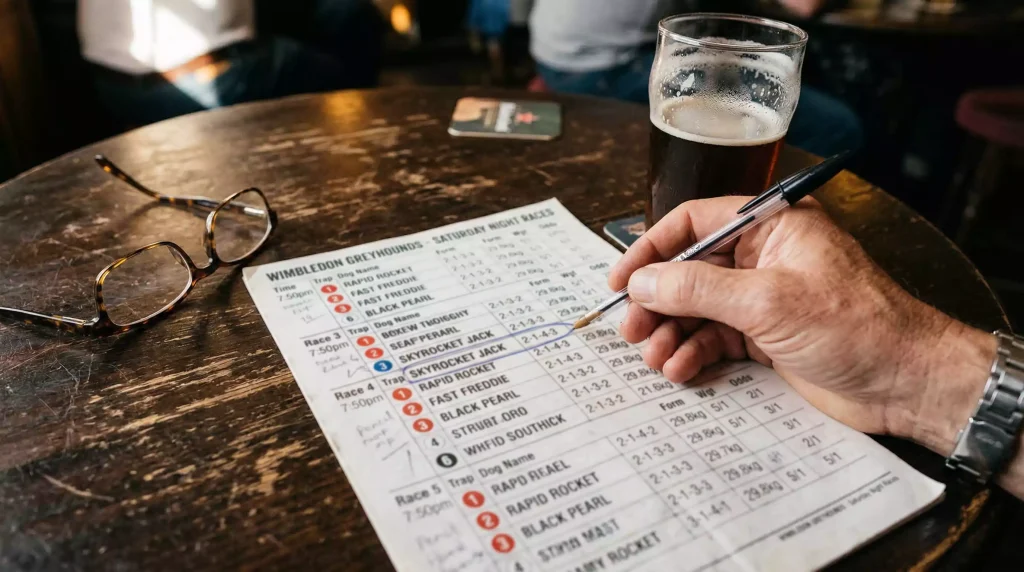
Form is the single most useful tool available to anyone who watches greyhound racing with a purpose beyond casual entertainment. It tells you where a dog has been, how it performed, and — if you read it carefully enough — where it might be heading. In a sport where total prize money across GBGB-licensed racing exceeds £15.7 million annually, the difference between a smart selection and a blind guess often comes down to fifteen minutes spent studying the greyhound racing form guide before a meeting.
This guide explains how to read form figures from scratch, identifies the key factors that shape a dog’s performance, and walks through a practical example of analysing a real race card. No prior knowledge required — just a willingness to look at the numbers rather than relying on names, colours, or gut feelings.
Decoding Form Figures: What Each Number and Letter Means
Form figures are the string of numbers and letters that appear next to each dog’s name on a race card. They represent the dog’s finishing positions in its most recent races, read from left to right in chronological order. A form line of 1-3-2-1-4 tells you the dog won two starts ago, finished third the time before that, and was fourth in its most recent outing.
Numbers 1 through 6 indicate finishing position in a standard six-dog race. A letter replaces the number in certain circumstances: “F” means the dog fell during the race, “T” means it was involved in a trap malfunction, and “B” indicates the dog was bumped heavily enough to affect its run. Some race cards include “D” for disqualified or “W” for withdrawn. These letters carry important contextual information — a dog showing 1-2-F-1-3 was performing consistently before a fall, which may or may not have caused a lasting issue.
The most recent run sits on the right of the form string. This matters because greyhound form is volatile — dogs can improve or decline sharply over a few weeks, particularly younger dogs still developing or older dogs approaching the end of their career. A dog showing 5-5-6-2-1 is on an improving trajectory; one showing 1-1-2-4-6 is heading the other direction. The direction of the form line often matters more than any individual figure within it.
Race cards also display the grade of each previous run and the track where it took place. A dog that finished second in an A1 open race at Nottingham was competing at a much higher level than one that won an A8 at a BAGS fixture. Reading the grade alongside the position gives you a sense of context: a fourth-place finish in a high-grade race may represent better form than a first in a lower one.
Key Factors: Trap, Distance, Going, and Trainer
Form figures alone do not tell the full story. Four external factors shape a dog’s performance at least as much as its raw ability, and a greyhound racing form guide that ignores them is incomplete.
Trap Draw
The trap a dog starts from affects its chances significantly. Inside traps — 1 and 2 — favour dogs that rail, meaning they naturally run close to the inside line through the bends. Outside traps — 5 and 6 — suit wide runners that prefer to sweep around the field. A dog with a form line of 1-1-2 from trap 1 at a track with strong inside bias may struggle from trap 5 at the same venue. Always check whether the dog’s form was accumulated from favourable or unfavourable draws.
Distance
Greyhound races in the UK are run over distances ranging from 250 metres (sprint) to 710 metres (staying). Most dogs have an optimal distance, and their form reflects it. A dog that wins comfortably over 480 metres may tire over 640, and vice versa. The race card shows the distance of each previous run, so you can assess whether the dog is being asked to race at its preferred trip.
Going
Track conditions — rated from fast through normal to slow — affect race times and suit different running styles. A front-runner that sets a fast early pace often prefers faster going, where the surface allows it to maintain speed through the bends. A dog that finishes strongly may benefit from slower going, where early-pace dogs tire. Comparing times across different going conditions requires adjustment, and the best form services provide calculated or normalised times for this purpose.
Trainer
Approximately 500 licensed trainers operate across the UK, and their records at individual tracks vary widely. Some trainers specialise in sprint dogs; others focus on stayers. Some have a strong record at specific venues; others spread their runners more evenly. Trainer statistics are available on Racing Post and Timeform, and filtering by track and distance can reveal patterns that the dog’s raw form does not show. A trainer with a 25% strike rate at Romford over 400 metres is placing their dogs with purpose, and that placement should factor into your assessment.
Putting It Together: Analysing a Real Race Card
Imagine a six-dog race over 480 metres at Nottingham, normal going. You have the race card in front of you. Here is how to work through it systematically using the greyhound racing form guide approach.
Start with the form figures. Look for dogs on improving sequences — rising positions across their last three or four runs. Eliminate dogs whose form is clearly declining unless you have a specific reason to think the decline was caused by a correctable factor (wrong distance, poor trap draw, going too firm).
Next, check the trap draw. Nottingham has a moderate inside bias over 480 metres, so dogs in traps 1 and 2 have a statistical edge. If the best form dog is drawn in trap 6, you need to weigh its raw ability against the disadvantage of starting wide. If a dog with slightly weaker form has trap 1 and a strong railrun style, it may be the smarter selection.
Look at recent times adjusted for going. A dog that ran 29.30 on slow going may be faster than one that ran 29.10 on fast going, once the surface difference is factored in. Racing Post and Timeform provide adjusted or calculated times for this purpose — use them rather than comparing raw figures.
Finally, check the trainer angle. If one dog’s trainer has a notably strong record at Nottingham over 480 metres, that is a signal worth heeding. Trainers who place their dogs well understand the track geometry, the going tendencies, and the trap biases at individual venues, and their record at a track reflects that knowledge.
None of this guarantees a winner. Greyhound racing is unpredictable by nature — bumping on the first bend, a slow start from the traps, or a hare malfunction can override the best analysis. But a greyhound racing form guide approach gives you a framework for making informed selections rather than random ones, and over time, informed selections produce better results than guesswork.
Form: The Foundation of Smart Viewing
Reading form is not just for bettors. It changes the way you watch a race. When you know which dog is improving, which is drawn badly, and which prefers slow going, the thirty seconds of action become a test of your analysis rather than a random spectacle. You watch the first bend to see whether the inside dog got the rail. You check the final straight to see whether the stamina specialist closed as you expected. The racing gains a narrative that it does not have when you watch blind.
Start with the form figures. Add in trap, distance, going, and trainer. Give it three or four meetings, and the greyhound racing form guide will feel like second nature — and the sport will feel like a completely different experience.
The wider context is set out in our guide to watching greyhound racing.
Turning form into a selection is covered in racing tips.
