
Greyhound Racing History UK: From Belle Vue 1926 to the Modern Era
Best Greyhound Betting Sites – Bet on Greyhounds in 2026
Loading...
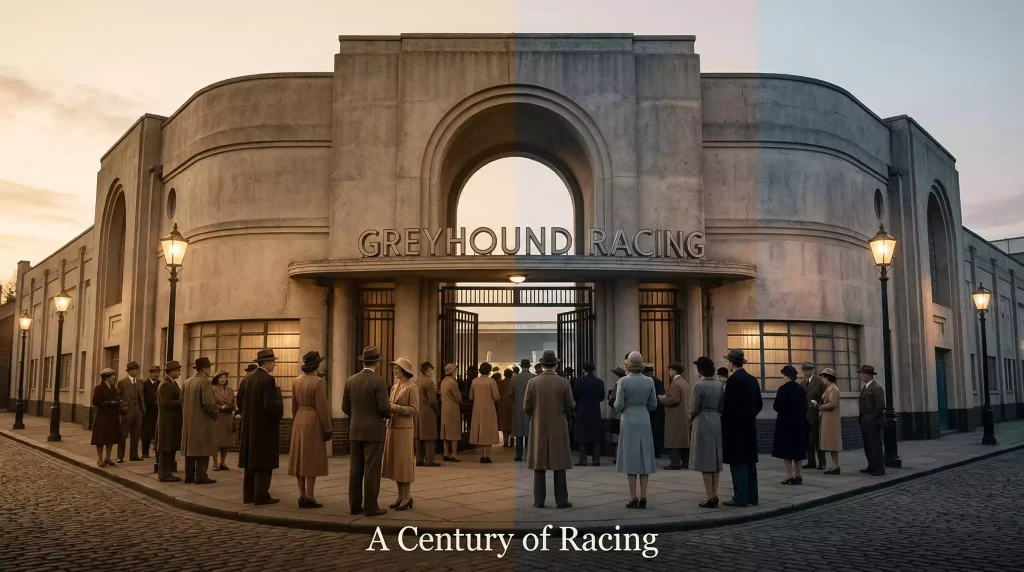
Greyhound racing history UK spans exactly one century — from the first regulated race at Belle Vue in Manchester in 1926 to the opening of Dunstall Park in Wolverhampton in 2025. In between, the sport rose to become one of Britain’s biggest spectator attractions, fell into a long decline marked by stadium closures and cultural irrelevance, and has spent the last two decades trying to reinvent itself for a new era.
Understanding the history is not just nostalgia. The sport’s past explains its present: why there are only 18 licensed tracks left, why the relationship with bookmakers is so fraught, why welfare became the defining issue of the modern era, and why the debate over whether greyhound racing has a future continues to this day. This is the story of how the dogs arrived, thrived, declined, and — depending on who you ask — are coming back.
1926–1945: The Birth of Greyhound Racing in Britain
Greyhound racing arrived in Britain from the United States in 1926. The catalyst was the mechanical hare — a motorised lure that ran on a rail around an oval track, allowing greyhounds to chase prey without involving live animals. The concept had been tested in America, and a group of entrepreneurs saw an opportunity to bring it across the Atlantic as a commercial entertainment venture.
The first licensed meeting took place at Belle Vue Stadium in Manchester on 24 July 1926. It was an immediate sensation. Within months, tracks were opening across the country — White City in London, Hall Green in Birmingham, Wimbledon in south-west London, Wembley, Harringay, and dozens more. By the end of 1927, there were more than forty licensed tracks in operation, and the sport was drawing crowds that rivalled football.
The appeal was partly the racing itself — fast, dramatic, and easy to understand — and partly the social experience. Greyhound stadiums were built as entertainment complexes: restaurants, bars, totalisator betting, music, and a night out that was accessible to the working and middle classes in a way that horse racing, with its social hierarchies, often was not. The greyhound track was democratic. You paid a shilling at the gate and you were in.
The 1930s were a golden decade. Attendance figures at the biggest tracks regularly exceeded 50,000, and the sport generated enormous revenue through the tote (on-course betting pools). The National Greyhound Racing Club (NGRC) was established to regulate the sport, licensing tracks, trainers, and officials. By the time World War II interrupted civilian entertainment in 1939, greyhound racing was firmly established as one of Britain’s most popular spectator sports.
The war did not stop racing entirely. Some tracks closed, but others continued to operate, and greyhound meetings became a form of escapism for a population under siege. Attendance at open tracks remained high, and the sport emerged from the war years with its audience largely intact.
1945–2000: Peak Popularity and the Long Decline
The immediate post-war period was greyhound racing’s absolute peak. In 1946, total attendance across UK tracks was estimated at over 50 million — a figure that dwarfed football, cricket, and every other spectator sport. The tracks were packed, the tote turned over millions, and the English Greyhound Derby at White City was one of the biggest events in the British sporting calendar.
The decline began in the 1960s, driven by three forces that would reshape British entertainment over the next four decades. The first was television. As households acquired sets, the appeal of going out to watch sport diminished — people could watch football, cricket, and horse racing at home. The second was the betting-shop revolution. The legalisation of off-course betting shops in 1961 meant punters no longer needed to attend the track to place a bet. The third was property values. Greyhound stadiums sat on prime urban land, and as land prices rose, the economic logic of running a greyhound track on a site that could house hundreds of flats became increasingly difficult to defend.
Closures accelerated through the 1970s, 1980s, and 1990s. White City — the grandest of them all, with its 90,000 capacity and Art Deco grandeur — closed in 1984. Wembley followed. Harringay, Catford, Hackney, Park Royal — track after track disappeared, replaced by supermarkets, housing estates, and retail parks. The sport that had drawn 50 million spectators a year was, by the turn of the millennium, struggling to fill its remaining stadiums.
The cultural shift was equally damaging. Greyhound racing was increasingly associated with gambling, decline, and a working-class identity that mainstream media treated with condescension. The sport lost its glamour, its media coverage, and its sense of being a legitimate part of Britain’s entertainment landscape. By 2000, the question was not whether greyhound racing was declining — it was whether it would survive at all.
2000–Present: Regulation, Reform, and Renewal
The modern era of greyhound racing history UK begins with regulation. In 2009, the NGRC was replaced by the Greyhound Board of Great Britain (GBGB), which took on a broader mandate that included welfare, data transparency, and industry modernisation. The transition was not seamless — the early years of the GBGB were marked by funding disputes and resistance from parts of the industry — but it established a governance framework that the sport had previously lacked.
Welfare became the defining issue. Under public and political pressure, the GBGB began publishing annual injury, fatality, and rehoming statistics — data the industry had previously kept private. The numbers told a mixed story: the sport had genuine problems (high injury rates, inconsistent rehoming, economic euthanasia) but was also capable of improving when incentivised to do so. Between 2018 and 2024, the rehoming rate rose from 88% to 94%, the on-track injury rate fell to a historic low of 1.07%, and economic euthanasia collapsed from 175 dogs a year to just three.
The commercial picture has stabilised without returning to anything resembling the post-war peak. Today the sport contributes £164 million annually to the UK economy and draws over two million visitors to its 18 licensed tracks each year. The BAGS system provides daily content for the bookmaking industry, and the Premier Greyhound Racing partnership with Sky Sports Racing — launched in January 2024 — gives the sport its highest-profile television deal in decades.
New investment has arrived, too. The opening of Dunstall Park Greyhound Stadium in September 2025 — the first new track in Britain in more than a decade — signalled confidence from Arena Racing Company that the sport can sustain modern infrastructure. Whether that confidence is justified depends on whether the current trajectory — improving welfare, growing attendance, better media deals — can be maintained.
A Century of Racing
Greyhound racing history UK is a story of spectacular rise, long decline, and cautious renewal. The sport that packed 50 million spectators into stadiums in 1946 now operates from 18 tracks with a fraction of that audience. But the sport that seemed destined for extinction at the turn of the millennium is still here, still running, and — in some respects — healthier than it has been in years.
A century after Belle Vue, the dogs are still chasing the hare. The question, as always, is whether enough people are still watching.