Greyhound Racing Glossary: Every Term a New Fan Needs to Know
Best Greyhound Betting Sites – Bet on Greyhounds in 2026
Loading...
Greyhound racing has its own language — a mix of technical terminology, betting jargon, and trackside shorthand that can leave newcomers feeling like they have walked into a conversation halfway through. The sport’s community includes roughly 500 licensed trainers, 15,000 registered owners, and thousands of regular attendees who use this vocabulary without thinking, which makes it easy to feel excluded if you do not know the basics.
This greyhound racing terminology guide covers the words and phrases you will encounter most often: on race cards, in commentary, on results pages, and in conversation at the track. It is not exhaustive — the sport has accumulated a century of jargon — but it covers everything a new viewer or punter needs to know to follow the action without reaching for a dictionary. The terms are arranged alphabetically for quick reference.
A–F: From “All England Cup” to “Forecast”
All England Cup. One of the major annual competitions in UK greyhound racing, held at Newcastle. Part of the Premier Greyhound Racing calendar.
BAGS. Bookmakers’ Afternoon Greyhound Service — the system that provides daytime racing fixtures for off-course betting. BAGS meetings run from late morning through to mid-afternoon, every day of the week, at rotating GBGB-licensed stadiums.
Bumped. When a dog makes physical contact with another dog during a race, usually on a bend. Being bumped can cost a dog several lengths and significantly affect its finishing position. Results pages often note bumping as context for a poor run.
Checked. When a dog is forced to slow down or change direction because of interference from another runner. Checking is less severe than bumping but still affects performance.
Distance. The length of a race, measured in metres. Common distances at UK tracks include 250m (sprint), 400m (standard), 480m (middle distance), and 640-710m (staying). The distance is always listed on the race card.
Each-way. A bet that covers both a win and a place (typically finishing first or second). An each-way bet is effectively two bets: one on the dog winning, one on it finishing in the top two. The place part pays at a fraction of the win odds, usually one quarter.
Forecast. A bet that requires you to predict the first two finishers in the correct order. A reverse forecast covers both possible orderings. Forecasts pay higher dividends than straight win bets because they are harder to land.
G–O: From “Graded Racing” to “Open Race”
GBGB. Greyhound Board of Great Britain — the governing body for licensed greyhound racing in the UK. Responsible for regulation, welfare standards, and the licensing of tracks, trainers, and officials. All 18 currently active stadiums in England and Wales operate under GBGB licences.
Going. The condition of the track surface, assessed by officials before each meeting. Rated on a scale from fast (dry, firm surface producing quick times) through normal to slow (softer surface, often after rain). The going directly affects race times and should be factored into any form analysis.
Graded racing. A system that classifies dogs by ability. Grades run from A1 (highest) through A10 or lower, with separate categories for sprint and staying distances. Dogs move between grades based on their recent results — winners are promoted, losers are demoted. The grading system ensures competitive races by grouping dogs of similar ability.
Hare. The mechanical lure that the dogs chase around the track. Modern UK tracks use either an inside hare (running on a rail inside the track) or an outside hare. The hare operator controls its speed to stay ahead of the leading dog.
Kennel turn. The sharp bend at the end of the back straight where dogs transition toward the home turn. Some tracks have tighter kennel turns than others, which affects racing styles — dogs that handle tight bends well have an advantage at tracks like Romford.
Length. The standard unit for measuring distances between finishers. One length equals approximately 0.08 seconds. A dog winning by three lengths has a comfortable margin; a short head is the smallest measurable gap.
Open race. A race not restricted by grade — any dog can enter, regardless of its current grading. Open races typically attract higher-quality fields and carry larger prize money than graded races. Evening meetings at major tracks often feature several open races.
P–Z: From “Photo Finish” to “Wide Runner”
Photo finish. When two or more dogs cross the line so closely together that the finishing order cannot be determined by the naked eye. A camera captures the exact moment and officials examine the image to declare the result. Photo finishes add a few minutes to the announcement.
Premier Greyhound Racing (PGR). The umbrella body that coordinates the top-tier greyhound racing fixtures in the UK. Since January 2024, PGR events are broadcast exclusively on Sky Sports Racing.
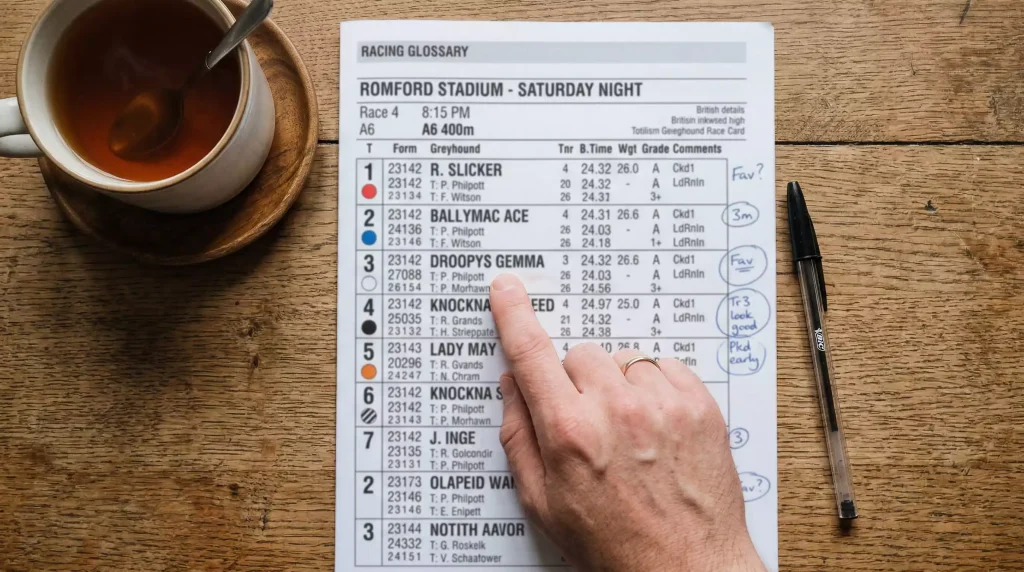
Race card. The printed or digital document listing all the races at a meeting, with details of each runner: name, trap number, trainer, recent form figures, weight, and sometimes predicted times. Reading the race card is the first step in understanding any greyhound meeting.
Railer. A dog that naturally runs close to the inside rail. Railers tend to perform best from traps 1 and 2, where they can hug the inside line through the bends. The opposite is a wide runner.
Sectional time. The time taken to reach the first bend or a specific intermediate point on the track. Sectional times reveal early pace — a dog with a fast sectional is a front-runner that likes to lead from the traps.
SP (Starting Price). The final odds offered by bookmakers at the moment the race starts. The SP is the official price used for settling bets when no specific odds were taken in advance.
Trap. The numbered starting box from which each dog begins the race. UK tracks use six traps, colour-coded: 1 (red), 2 (blue), 3 (white), 4 (black), 5 (orange), 6 (black and white stripes). Trap draw significantly affects race outcomes, particularly at tracks with strong trap bias.
Trap bias. A statistical tendency for certain traps to produce more winners at a particular track. Bias depends on track geometry — the angle of the first bend, the width of the home straight, the camber of the turns. Some tracks heavily favour inside traps; others are fairer across the draw.
Tricast. A bet that requires predicting the first three finishers in exact order. Tricasts are high-risk, high-reward bets that pay large dividends when they land.
Wide runner. A dog that naturally takes a wider path around the bends. Wide runners suit traps 5 and 6 and tend to struggle from inside draws, where they have to navigate around other dogs to reach their preferred running line.
Speak the Language of the Dogs
Greyhound racing terminology does not take long to learn once you start watching regularly. Most terms describe things you can see — the trap, the hare, the bumping on the bends — and the betting jargon follows the same logic as any other sport. Give it a few meetings, and the language stops being a barrier and starts being a shortcut to understanding what you are watching.
Keep this glossary bookmarked for quick reference, and the next time a commentator mentions a checked railer with a slow sectional out of trap six, you will know exactly what happened — and why it matters.