How Does Greyhound Racing Work: Rules, Race Cards, and Track Basics
Best Greyhound Betting Sites – Bet on Greyhounds in 2026
Loading...
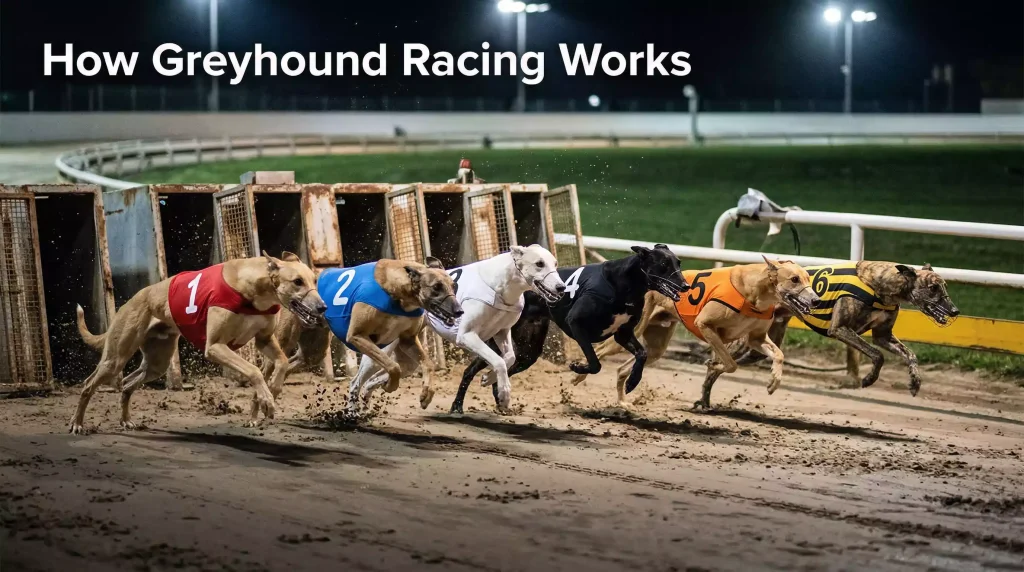
You are watching a greyhound race for the first time. Six dogs burst from the traps, a blur of colour and speed around an oval track, and thirty seconds later it is over. Someone near you is cheering. Someone else is tearing up a betting slip. And you are standing there thinking: what just happened?
That experience is more common than the sport’s regulars like to admit. Greyhound racing looks simple on the surface — dogs chase a mechanical lure around a track — but underneath that simplicity lies a structured system of rules, classifications, and data that determines which dogs run against each other, on what terms, and for what stakes. Understanding how does greyhound racing work, even at a basic level, transforms the experience from a confusing spectacle into something you can follow, analyse, and enjoy.
The scale of the operation behind each race meeting is worth appreciating. Licensed greyhound racing in the UK is overseen by GBGB, the sport’s governing body, which regulates everything from kennel conditions to race-day drug testing. The industry supports around 500 licensed trainers and approximately 15,000 registered owners, with roughly 6,000 new greyhounds entering the system each year. “Greyhound racing is enshrined in British culture and contributes £164 million a year to the economy, employs 5,400 people, and remains one of the top 10 spectator sports in the UK,” Mark Moisley, GBGB’s Commercial Director, noted in 2025 — figures that reflect a professional, regulated sport rather than the casual pursuit some assume it to be.
This guide explains how does greyhound racing work from the ground up. We will walk through a race from start to finish, decode a race card so you can read one without help, explain the grading system that determines the quality of competition, and define the terminology that insiders throw around as if everyone already knows it. By the end, you will know enough to watch any race meeting — live at the track, on television, or through a stream — and understand what is going on.
The Anatomy of a Greyhound Race: Start to Finish
Every greyhound race follows the same essential sequence, whether it is a Monday afternoon BAGS fixture or the final of the English Greyhound Derby. The structure is standardised because consistency matters — for the dogs, the trainers, the officials, and the betting market. Here is what happens, step by step.
Before the Race: Parade and Traps
Before each race, the competing greyhounds are brought to the parade ring. At a stadium, this is the moment when you can see the dogs up close — their condition, their temperament, how they are moving. Experienced racegoers watch the parade carefully, looking for signs of fitness or nervousness. A dog that is pulling eagerly on the lead and looks alert is generally considered to be in better shape than one that appears reluctant or distracted.
Each dog wears a coloured jacket corresponding to its trap number. The colours are standardised across all GBGB-licensed tracks: trap one is red, trap two is blue, trap three is white, trap four is black, trap five is orange, and trap six is black and white striped. In races with more than six runners — which are rare in the UK — additional colours are used. Knowing the trap colours is the quickest way to follow your dog during the race, because the commentary will often refer to them by colour rather than name during the rapid early stages.
After the parade, the dogs are loaded into the starting traps — a row of spring-loaded boxes positioned at the start line. Each dog enters the trap corresponding to its assigned number. The trap draw is not random for graded races; it is determined by the racing manager based on the dogs’ running styles. A dog that tends to run wide might be drawn in an outside trap, while an early-speed dog might be placed on the inside rail.
The Start
Once all dogs are loaded, the mechanical lure — often called the hare, though it bears no resemblance to an actual animal — begins its run along the rail on the outside of the track. The lure accelerates past the traps, and at the precise moment, the traps spring open simultaneously. The dogs break and give chase.
The start is critical. A dog that exits its trap cleanly and reaches the first bend in a good position has a significant advantage. Greyhound races are short — typically 30 to 45 seconds for standard distances — and there is limited time to recover from a poor start. This is why trap draw and early speed are among the most analysed factors in greyhound form study.
The Race
The greyhounds chase the lure around the track at speeds that can exceed 40 miles per hour. The lure stays ahead of the leading dog at all times, maintaining the chase instinct that drives the race. Most UK tracks are oval circuits, and a standard race involves one or two complete laps depending on the distance.
Crowding at the bends is where most of the drama — and most of the interference — occurs. Dogs on the inside rail have the shortest path but risk being boxed in. Dogs running wide cover more ground but have clearer running. Bumping, checking (where a dog is forced to slow down by another dog’s movement), and occasionally falling are all part of the sport. Stewards monitor every race for interference, and results can be amended if a dog is deemed to have been unfairly impeded.
The number of new greyhounds entering the sport gives some sense of the pool from which competitors are drawn. In 2024, GBGB registered 5,133 new greyhounds, down from 6,769 in 2021 — a decline that reflects tighter breeding regulations and an increased proportion of British-bred dogs entering the system.
The Finish and Result
The first dog to cross the finish line wins. Photo-finish technology is used at all licensed tracks to determine close results. After the race, the official result is declared, any stewards’ enquiries are resolved, and the starting price (SP) is confirmed. The entire process — from traps opening to result declared — takes no more than two to three minutes for a standard race. A twelve-race meeting will typically run for around two and a half hours, with intervals of ten to fifteen minutes between races.
How to Read a Race Card Like a Regular
The race card is the single most important document in greyhound racing. It is your programme, your form guide, and your betting reference rolled into one. Every meeting publishes a race card — either as a physical printed sheet available at the track or as a digital listing on platforms like the Racing Post, RPGTV, and bookmaker websites. Learning to read one is the fastest way to go from confused spectator to informed viewer.
What the Card Contains
A standard greyhound race card presents the following information for each race: the race number, the race time, the distance, the grade, and a line of data for each competing dog. Each dog’s entry typically includes its trap number, name, trainer, recent form figures, best recent time at the distance, early speed rating, weight, and breeding (sire and dam). That sounds like a lot of data, and it is — but you do not need to absorb all of it at once.
Start with three things: the dog’s name, its trap number, and its recent form. The form is usually displayed as a sequence of numbers representing finishing positions in the last five or six races, read from left to right (most recent first). A dog showing “1-2-1-3-1” has won three of its last five races and never finished worse than third. A dog showing “6-5-6-4-5” has been struggling. That simple pattern — low numbers good, high numbers bad — gets you surprisingly far as a starting point.
Understanding the Key Data Points
Beyond form, the race card offers several data points that regulars use to assess a dog’s chances:
Best Time: This is the dog’s fastest recorded time at the race distance, sometimes at the specific track. It is useful for comparing raw speed, but it comes with a caveat — times are influenced by track conditions, running line, and whether the dog had a clear run. A fast time recorded in a solo trial is less meaningful than one recorded in a competitive race.
Early Speed: Some cards include an early-speed rating, which estimates how quickly the dog reaches the first bend from the traps. High early speed is a significant advantage in greyhound racing because it determines race position before the first turn, where crowding is most intense.
Weight: The dog’s racing weight at its most recent outing. Significant weight changes between races can indicate changes in fitness or condition. A drop of more than half a kilogram from one race to the next might suggest the dog has been off its feed, while a steady weight is generally a positive sign.
Trainer: The trainer’s name matters more in greyhound racing than casual viewers realise. Certain trainers consistently produce winners at specific tracks, and knowing which trainers are in form can be as useful as studying the dogs’ individual records. Over time, you will learn which names signal quality and which signal caution.
Where to Find Race Cards
Race cards are published daily on the Racing Post website, the RPGTV section of the Racing Post, and through all major bookmaker platforms. Physical cards are available at the track for a small charge (usually included in the admission price). The digital versions tend to be more detailed, with additional statistics and comment from form analysts. If you are watching from home, the digital race card is your primary tool — pull it up alongside the stream and follow each race with the data in front of you.
Grades, Distances, and Track Categories Explained
If you have ever wondered why some greyhound races feel more competitive than others, the grading system is the answer. Every dog racing at a GBGB-licensed track is assigned a grade that reflects its current ability, and races are structured so that dogs of similar standard compete against each other. This keeps the racing competitive, the results less predictable, and — not incidentally — the betting markets more interesting.
How Grading Works
The grading system operates on an ascending scale at each individual track. Grades are typically labelled with letters — A being the highest, through to D or lower depending on the stadium. The specifics vary by track because each venue has its own grading structure calibrated to its particular circuit and the pool of dogs available to its racing manager.
A dog’s grade is not fixed. It moves up or down based on recent results. A dog that wins consecutive races at its current grade will be promoted — moved up to a higher grade where the competition is stiffer. A dog that finishes consistently at the back of the field will be dropped to a lower grade where it has a better chance of being competitive. The system is designed to be self-correcting: over time, every dog settles at the grade where it is competitive but not dominant.
Understanding how does greyhound racing work at the grading level explains a common point of confusion for newcomers: why a dog that won its last race starts at seemingly long odds in its next one. The answer is usually that it has been promoted. It won against D-grade opposition and is now facing C-grade dogs. Its form figures still show a “1” from last time, but the context has changed entirely.
Open Races and Premier Events
Above the standard grading ladder sit open races, which are not restricted by grade. These are the sport’s premium competitions, drawing the best dogs from across the country. The English Greyhound Derby, the Greyhound St Leger, the Oaks, and the category races at individual tracks are all open events. The prize money reflects the quality: the total prize fund across all GBGB-licensed racing reached £15.7 million, with the Derby alone offering £175,000 to the winner.
Open racing is where the sport reaches its highest competitive level. The dogs are faster, the margins are tighter, and the tactical element — trap draw, early speed, running line — becomes more decisive. For new viewers, watching an open race after getting used to graded racing is like moving from club football to international level: the same game, but faster and with fewer mistakes.
Distances
Greyhound races in the UK are run over standardised distances, measured in metres. The most common distances are 265m (sprint), 400–480m (standard), 640m (middle distance), and 840m-plus (stayers). Each track has its own set of available distances, determined by the circumference and configuration of the circuit. The 18 GBGB-licensed stadiums vary in size, which means that a “standard” race at Romford covers a different distance from a “standard” race at Towcester.
Distance preference is a key element of greyhound form. Some dogs are natural sprinters — they explode from the traps and cannot sustain their speed over longer distances. Others are stayers who accelerate through the later stages of a race. Matching a dog’s preferred distance to the race conditions is one of the basic skills of form analysis, and the race card will usually indicate whether a dog has experience at the distance in question.
Track Categories
GBGB-licensed tracks are categorised by the level of racing they host. Tracks that hold Premier Greyhound Racing events — the flagship meetings broadcast on Sky Sports Racing — sit at the top of the hierarchy. Below them are tracks that run regular graded and open racing on a weekly schedule. At the base are tracks that primarily serve the BAGS daytime circuit, providing content for bookmaker feeds. The full regulatory framework, including rules of racing and kennel standards, is published through GBGB’s official website.
The category of the track affects the quality of the fields and the prize money on offer, but it does not affect the rules. The same GBGB regulations apply everywhere, from a Tuesday afternoon at Sunderland to the Derby final at Towcester. How does greyhound racing work differently at a premier venue? The competition is sharper, the dogs are better, and the atmosphere is bigger — but the mechanics of each race are identical.
Form Figures and Key Terminology Glossary
Greyhound racing has its own language. Some of it is self-explanatory, some of it is borrowed from horse racing, and some of it is genuinely obscure. This section covers the terms you will encounter most often when reading race cards, watching commentary, or following the sport through any medium.
Reading Form Figures
Form figures are the compressed history of a dog’s recent racing career. They appear as a string of numbers on the race card, typically covering the last six runs. Each number represents the finishing position in that race. The most recent run appears first (on the left), so the sequence reads from newest to oldest.
Special characters appear alongside the numbers to convey additional information. A dash (-) separates individual runs. The letter “T” indicates a trial run rather than a competitive race. “F” means the dog fell during the race. “S” means it was slow to leave the traps. These modifiers change the meaning of the form significantly — a finishing position of 5 followed by “ck” (checked, meaning the dog was impeded) tells a different story from a clean run to fifth place.
Here is a worked example. A form line reading “1-3-2ck-1-5F-2” tells you: the dog won its most recent race; finished third in the race before that; was checked (impeded) in the race before that but still managed second; won the one before that; fell during the next-oldest race but had been running fifth at the time; and finished second in the oldest race shown. That is a dog with ability but some bad luck — the two poor results both have mitigating circumstances.
Essential Terminology
Trap (or Box): The starting position. Traps are numbered 1 (inside rail) to 6 (outside). The trap number determines the coloured jacket the dog wears.
Graded Race: A race restricted to dogs of a particular standard at that track. Most races on a standard meeting card are graded.
Open Race: Unrestricted by grade. Open races attract the best available dogs and carry higher prize money.
BAGS: Bookmakers’ Afternoon Greyhound Service. The scheduling system that organises daytime meetings for the off-track betting market.
SP (Starting Price): The official odds at the moment the traps open. Determined by on-course bookmakers or by a starting-price formula derived from exchange and bookmaker markets.
Forecast: A bet requiring you to predict the first and second finishers in the correct order.
Tricast: A bet requiring the first three finishers in exact order. Harder to land than a forecast, but the payouts are correspondingly larger.
Each-Way: A bet split into two parts — one on the dog winning, one on it placing (usually first or second in a six-dog race). If the dog wins, both parts pay. If it places but does not win, only the place part pays, at a fraction of the win odds.
Sectional Time: The time a dog takes to reach a particular point on the track, usually the first bend. Used to assess early speed independently of the overall finishing time.
Running Line: The path a dog takes around the track. Rails runners hug the inside. Wide runners drift towards the outside. Middle-track runners take a path between the two. A dog’s running line affects which trap draws suit it best.
Bumped / Checked / Crowded: Interference during the race. “Bumped” means the dog made contact with another dog. “Checked” means it was forced to alter its stride or direction. “Crowded” means it was squeezed between runners. All three can significantly affect finishing position and should be noted when assessing form.
Hare: The mechanical lure that the dogs chase. It runs on a rail around the outside of the track, always staying ahead of the lead dog. Despite the name, it is usually a simple arm or shape designed to trigger the chase instinct rather than to resemble an animal.
Kennel Turn: The term for the first bend on the track, typically the point where most interference occurs as dogs jostle for position after the break from the traps.
This is not an exhaustive glossary — the sport has hundreds of specialist terms — but knowing these will cover the vast majority of what you encounter in commentary, race cards, and form analysis. As your familiarity grows, the more obscure terms will accumulate naturally.
Ready to Watch Your First Race
Understanding how does greyhound racing work is not about memorising every rule and term in a single sitting. It is about having enough context to follow the action, read the data, and appreciate what you are watching. The basics — trap colours, form figures, the grading system — are enough to get you through your first meeting without feeling lost.
The rest builds with experience. After a few meetings, you will start recognising trap-draw patterns: which dogs prefer the inside rail, which ones need room to run wide. You will notice which trainers keep producing winners at specific tracks. You will develop an instinct for reading form that no guide can teach, because it comes from watching hundreds of races and absorbing the patterns.
Start with a race card and a live stream. Follow two or three races without betting, just watching how the form translates into performance. Notice how the trap draw affects the first bend. Notice how the grade of the race affects the quality and predictability of the result. Once you feel comfortable reading the card and anticipating what might happen, you are no longer a complete beginner — you are a racing fan who happens to be early in the journey. The dogs have been doing this for a century. You have all the time in the world to catch up.