Greyhound Rehoming UK: How to Adopt a Retired Racing Dog
Best Greyhound Betting Sites – Bet on Greyhounds in 2026
Loading...
Every year, thousands of greyhounds finish their racing careers and need new homes. In 2024, 94% of the 6,160 dogs that left licensed racing in the UK were successfully rehomed — the highest rate on record and a significant improvement from 88% in 2018. As GBGB chief executive Mark Bird has noted, the welfare initiatives introduced over recent years are now embedded and delivering consolidated progress across all measures. Greyhound rehoming UK is working better than it ever has.
But 94% is not 100%, and the sheer number of dogs moving through the system means the demand for adoptive homes remains constant. With 5,133 new greyhounds registered for racing in 2024 alone, the pipeline of future retirees is large and ongoing. The sport relies on a network of charities, foster carers, and individual adopters to give these dogs a second life — and the good news is that greyhounds make genuinely excellent pets, which makes the rehoming process easier than many prospective owners expect.
This guide covers where to adopt, what the process involves, and what life with a retired racing greyhound is actually like.
Where to Adopt: The Greyhound Trust and Other Charities
The Greyhound Trust is the largest breed-specific rehoming charity in the UK and the primary partner of the GBGB’s rehoming programme. It operates a network of regional branches across England, each of which takes in retired racers, assesses their temperament and health, and matches them with suitable homes. The Trust has rehomed tens of thousands of greyhounds since its founding and is the first point of contact for most people interested in greyhound rehoming UK.
Beyond the Greyhound Trust, a number of independent charities and rescue organisations also rehome retired racing greyhounds. Forever Hounds Trust, Greyhound Rescue Wales, and local groups like Birmingham Greyhound Protection specialise in the breed and often take dogs that have more complex needs, whether medical or behavioural. Some operate waiting lists; others have dogs available immediately. The landscape is fragmented, which means casting a wide net — contacting multiple organisations across your region — often yields faster results than waiting for a single charity to find a match.
Some trainers and owners arrange direct rehoming, placing retired dogs with people they know or advertising through greyhound racing social-media networks. This route bypasses the formal charity process but can work well when the dog’s history and temperament are well understood. The GBGB encourages all rehoming to be done through its registered programme or through recognised charities, as this ensures the dog’s post-racing welfare is tracked and documented.
The availability of dogs varies by region and time of year. Branches near major racing tracks tend to have more dogs available, while branches in areas without a local stadium may have shorter waiting lists. If the branch nearest to you does not have a suitable dog immediately, it is worth contacting several branches or being prepared to travel — the right match is more important than proximity.
The Adoption Process: Steps, Costs, and Home Checks
The adoption process through the Greyhound Trust and most established charities follows a standard pattern designed to match each dog with a home that suits its temperament and needs.
The first step is an enquiry, usually submitted online or by phone. You will be asked about your living situation — house or flat, garden or no garden, other pets, children in the household, working patterns — to help the charity assess which dogs might be a good fit. Greyhounds can live in flats provided they get regular walks, but a secure garden is preferred. Homes with cats require a cat-tested dog, which narrows the pool of available animals.
A home check follows, conducted by a volunteer from the local branch. The volunteer visits your home to assess the environment: is the garden securely fenced? Is there a safe, quiet space for the dog to rest? Are there any obvious hazards? The check is not an inspection in the judgmental sense — it is a practical assessment to ensure the dog will be safe and comfortable. Most homes pass without issues.
Once approved, you will be matched with a dog based on your preferences and the charity’s assessment of the dog’s character. Some adopters want a specific age, sex, or colour. Others are happy to take whatever dog needs a home most urgently. The charity will introduce you to the dog, often through a meet-and-greet at the kennel, and if the match feels right, you take the dog home.
Adoption fees vary by charity but typically range from £175 to £300. This usually covers neutering or spaying, vaccinations, microchipping, worming, and a basic health check. Some charities include a starter pack with a coat, lead, and muzzle. The fee is a fraction of the cost of a puppy from a breeder, and the dog comes ready to settle into home life rather than requiring months of foundational training.
Life After Racing: What Retired Greyhounds Are Really Like
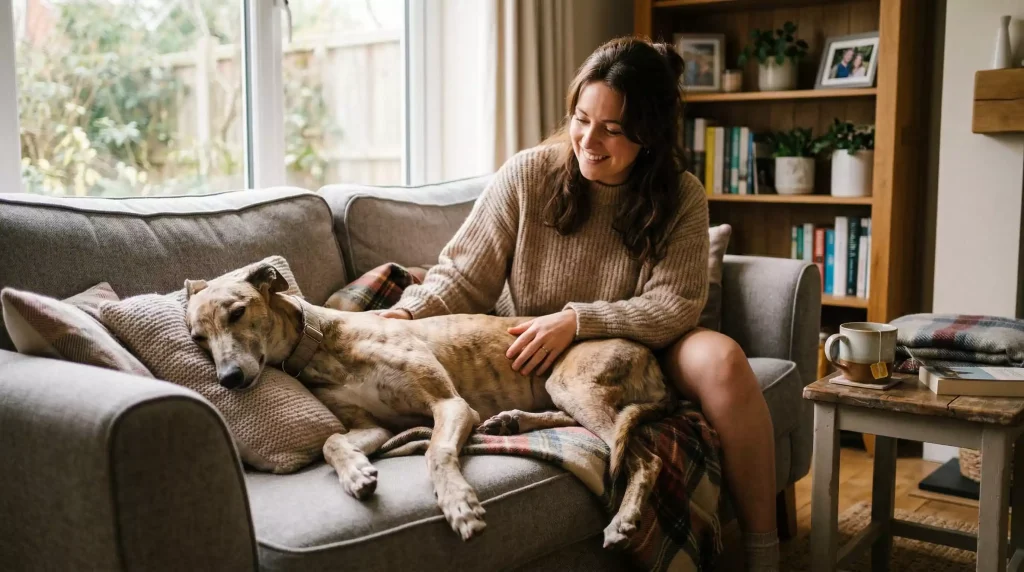
The most common misconception about retired racing greyhounds is that they need enormous amounts of exercise. They do not. Greyhounds are sprinters, not endurance athletes. A retired racer is perfectly happy with two twenty-minute walks a day and will spend the remaining hours asleep on your sofa, your bed, or whatever soft surface it can claim. The breed’s reputation for laziness is not an exaggeration — these dogs sleep for sixteen to eighteen hours a day and treat rest as a competitive sport in its own right.
Temperamentally, greyhounds are gentle, quiet, and affectionate. They rarely bark, they are not aggressive, and they bond closely with their owners. The transition from kennel to home can take a few weeks — the dog may be confused by stairs, mirrors, glass doors, and the general novelty of domestic life — but most greyhounds adapt quickly. They are creatures of routine, and once they learn the pattern of walks, meals, and sofa time, they settle into it with remarkable contentment.
There are a few practicalities to know. Greyhounds have thin skin and very little body fat, which means they feel the cold more than most breeds and often need a coat in winter. They have a high prey drive — this is, after all, a dog bred to chase — so letting them off the lead in unsecured areas requires caution and training. Muzzling in public is sometimes recommended during the early weeks until you understand your dog’s reactions to small animals. These are manageable considerations rather than deal-breakers, and most owners learn to navigate them within the first month.
Give a Greyhound a Second Career on Your Sofa
Greyhound rehoming UK is supported by a mature network of charities, a governing body that tracks outcomes, and a breed that happens to be one of the easiest large dogs to live with. The adoption process is straightforward, the costs are modest, and the dog you take home has already been assessed, vaccinated, and socialised in a kennel environment.
If you have ever thought about getting a dog and you can offer a quiet home, a secure garden, and a warm sofa, a retired greyhound might be the most rewarding pet you never expected. They gave the sport their speed. You can give them a retirement they deserve.