
Greyhound Racing Results Today: Where to Find Scores, Times, and Form
Best Greyhound Betting Sites – Bet on Greyhounds in 2026
Loading...
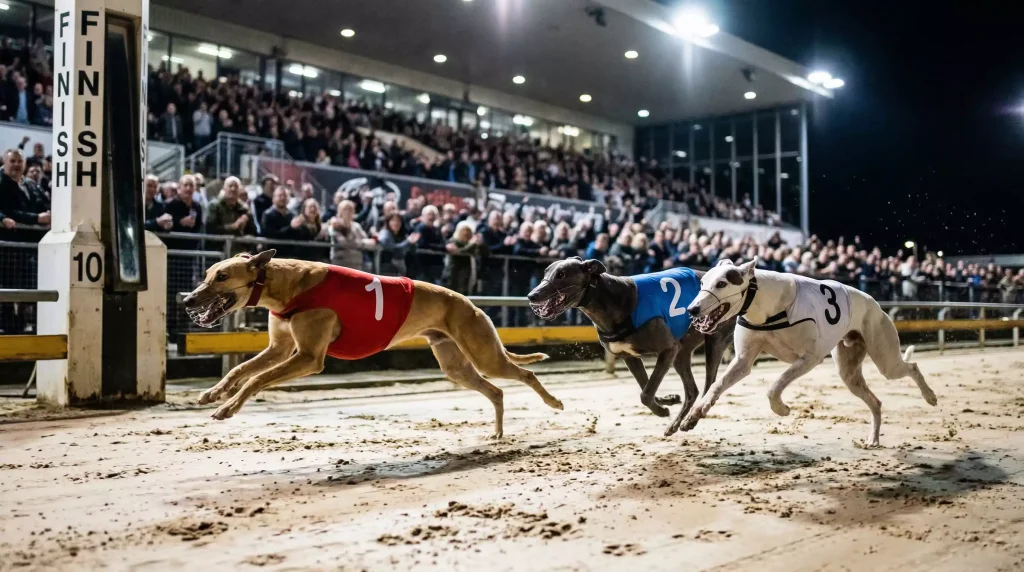
Greyhound racing produces a staggering volume of data. Across 18 GBGB-licensed stadiums, with BAGS fixtures running through the day and open-race meetings every evening, results pour in from mid-morning until well past ten o’clock at night. Each result carries a small stack of information — finishing positions, winning times, trap draws, distances between runners — and if you know where to find it and how to read it, that data turns from a list of numbers into a genuine edge.
Finding greyhound racing results today is not difficult. Half a dozen websites and apps publish them within seconds of a race finishing. The harder part is knowing what the numbers mean and how to use them beyond glancing at who won. A finishing time on its own tells you almost nothing. The same time at the same track on two different nights might reflect completely different levels of competition. Context is everything, and context comes from understanding the result format — then tracking it over time.
This guide covers the best sources for live and archived results, explains how to read every column in a standard results table, and shows how to turn individual results into a form profile that actually helps you predict what might happen next. The total prize money distributed across licensed racing exceeded £15.7 million in recent years, and behind every pound of that lies a result worth understanding.
Where to Get Live Results: Websites and Apps
The fastest route to greyhound racing results today depends on whether you want raw data or something you can actually analyse. For speed, bookmaker apps win. For depth, dedicated racing platforms are considerably better.
GBGB Website
The governing body publishes results for every licensed meeting. The data is official, verified, and includes finishing times, distances, starting prices, and trap draws. It is not the quickest to update — there can be a short lag compared to bookmaker feeds — but it is the most reliable source and the one you should treat as definitive when other platforms disagree. The results archive goes back several years, which makes it useful for long-term form analysis.
Racing Post
The Racing Post’s greyhound section offers the most detailed results service available to the public. Each result includes sectional times where available, calculated speeds, finishing margins in lengths, race comments from trackside reporters, and going descriptions. The archive is deep and searchable by dog name, trainer, or track. If you are serious about analysing form, this is the platform you will spend the most time on. Access is free for basic results, with some premium features behind a subscription.
Timeform
Timeform adds its own performance ratings to results, which gives each run a single-number summary of how good it was relative to the class of race. This is useful for comparing dogs that race at different tracks or over different distances. The interface is less cluttered than the Racing Post’s, and the ratings system — while proprietary — is widely respected in the greyhound community.
Bookmaker Apps
bet365, William Hill, Betfair, and Ladbrokes all display results within their greyhound sections, typically updating within thirty seconds of a race finishing. The data is basic — positions, times, starting prices — and there is rarely any race commentary or sectional analysis. But for a quick check of who won and at what odds, bookmaker apps are the fastest option, particularly if you are already using them to watch the stream.
Track Websites and Social Media
Individual stadiums often post results on their own websites and social-media accounts, occasionally with short video replays. This is useful if you follow a specific track — Romford, Nottingham, Towcester — and want to see results presented with local context. The downside is inconsistency: some tracks update promptly, others lag behind by hours or do not post at all on quieter nights.
How to Read Greyhound Racing Results: Times, Traps, and Margins
A standard greyhound racing result contains more information than most people realise on first glance. Here is what each element means and why it matters.
Finishing Position and Trap Number
The result lists each dog by finishing position — first through sixth — alongside the trap number it started from, usually colour-coded: red for trap 1, blue for 2, white for 3, black for 4, orange for 5, and black-and-white stripes for 6. The trap number matters because it determines where the dog starts on the track. Dogs in traps 1 and 2 have the inside rail; dogs in 5 and 6 run widest. Over time, certain traps at certain tracks produce more winners, a phenomenon known as trap bias. A result that shows trap 1 winning at a track with known inside bias is less impressive than the same result at a track where wide runners thrive.
Winning Time and Going
The winning time is the time in seconds taken by the first dog to cross the finish line. It is always read alongside the distance and the going. A 29.50-second run over 480 metres on normal going tells you something very different from a 29.50 over the same distance on slow going. The going — rated from fast through normal to slow — reflects the track surface condition and is set by officials before each meeting. Faster going generally produces quicker times, so comparing raw times across different going conditions is misleading unless you apply an adjustment.
Margins Between Runners
Distances between each finisher are measured in lengths, with one length roughly equivalent to 0.08 seconds. A result showing the winner beating the second dog by three lengths is a comfortable victory. A short head — the smallest measurable margin — means a photo finish. These margins tell you how competitive the race was and whether the winner dominated or scraped home. For form purposes, the second and third dogs in a tight finish often represent better future bets than a fourth-place finisher who trailed by ten lengths.
Starting Price and Forecast
The starting price (SP) is the final odds at which the winner was available before the race started. It tells you what the market thought of the dog’s chances. A 2/1 winner was expected to be competitive; a 10/1 winner was a surprise. Forecast and tricast dividends — the payouts for correctly predicting the first two or first three in order — are also listed, and they reveal how predictable the result was. A small forecast payout means the top two finished where the market expected. A large one means the result caught most people out.
Using Results to Track Form Over Time
A single result is a snapshot. Form is the film. Tracking a dog’s results across multiple races reveals patterns that individual results hide — whether it is improving, declining, suited to a particular track, or consistently struggling from a wide trap.
The simplest form tool is the run sequence, displayed as a string of numbers showing recent finishing positions. A dog with a run sequence of 1-2-1-3-1 is consistently competitive. One showing 4-5-6-5-6 is not. But sequences only tell part of the story. A dog that finished fifth in an open race at a higher grade might be a better prospect than one that won a lower-grade BAGS fixture by a length. This is where platforms like Racing Post and Timeform earn their value — they attach context to each run, so you can see not just the position but the quality of opposition, the going, and any trouble in running.
For anyone building a serious form profile, the key metrics to track over time are: winning time adjusted for going, sectional time to the first bend (which shows early pace), trap performance (does the dog run better from inside or outside?), and performance at specific tracks. Greyhounds are creatures of habit, and a dog that runs well at Romford’s tight 400-metre circuit may struggle at Towcester’s sweeping 500-metre oval. The GBGB has invested in improving the quality and transparency of its racing data in recent years — as Mark Bird, GBGB’s chief executive, noted when reviewing the 2024 figures, the initiatives introduced since 2018 are now embedded and consolidating measurable progress across the board.
Most form trackers maintain a simple spreadsheet or use the notes feature within Racing Post’s premium tools. You do not need anything sophisticated — just a record of each dog’s last five or six runs with the variables that matter most to your analysis. Over time, the patterns emerge on their own.
Stay on Top of Every Result
Greyhound racing results today are available within seconds of every race finishing, from the GBGB’s official records to bookmaker apps that update in near real-time. The challenge is not finding them — it is reading them properly. Finishing positions alone tell you who won. Times, margins, trap draws, and going conditions tell you why, and whether it is likely to happen again.
Start with one reliable source — the Racing Post for depth, the GBGB website for accuracy, or a bookmaker app for speed. Learn to read the full result rather than just the winner’s name. Track the dogs that interest you across multiple runs. The data is there, it is free, and for anyone willing to spend a few minutes interpreting it, the results stop being history and start becoming information.